Top 10 procure-to-pay (P2P) software platforms to consider in 2026

The best procure-to-pay software in 2026 depends on your ERP environment, spend complexity, and team size. Enterprise SAP shops gravitate toward SAP Ariba, Oracle-centric organizations fit naturally with Oracle Fusion Cloud Procurement, and companies seeking full spend consolidation look to Coupa or GEP SMART. Mid-market buyers prioritize fast deployment and intuitive adoption, making platforms like Procurify and Stampli strong contenders. This guide ranks 10 platforms across purchasing automation, invoice processing, supplier management, analytics, and total cost of ownership so you can shortlist with confidence.
Why P2P platform selection matters now
Procurement workloads are climbing while budgets remain flat. (The Hackett Group) reports that workloads are projected to increase by 10% in 2025, while budgets grow just 1%, creating a 9% efficiency gap. That gap is pushing finance and procurement leaders to replace manual handoffs, email-based PO follow-ups, and disconnected approval chains with unified procure-to-pay platforms.
At the same time, AI is reshaping what these platforms can do. Nearly half of procurement teams piloted generative AI use cases in 2024, more than double the share from the year before, though only 4% reported large-scale deployment (The Hackett Group). The implication: most organizations are still early in their automation journey, and the platform you choose now will shape how quickly you close that gap.
This list was built for procurement and finance leaders at mid-sized to large enterprises evaluating end-to-end P2P or source-to-pay solutions. We evaluated each platform on purchasing and PO automation, invoice and AP processing, supplier management, analytics, ERP integration depth, implementation effort, and total cost of ownership.
1. SAP Ariba
Overview
SAP Ariba is a cloud-based, end-to-end source-to-pay suite that connects buyers and suppliers on the world's largest business network. It automates procurement from requisition through payment and is natively embedded in the SAP ecosystem.
Strengths
- Native SAP ERP integration with guided buying, catalog management, and automated invoice matching against POs, contracts, and receipts
- Access to the world's largest business network for supplier collaboration, e-invoicing, and onboarding
- End-to-end compliance and spend visibility with AI-driven insights, approval workflows, and real-time analytics
- Recognized as a Gartner Magic Quadrant Leader for Source-to-Pay Suites in January 2026
Weaknesses
- Steep learning curve; certain functionalities require dedicated training and change management
- Limited configurability for tax and withholding calculations; integration with external tax engines can feel restrictive
- High total cost of ownership, with implementation and configuration costs adding significantly to subscription fees
Best for
Large SAP-centric enterprises running complex, multi-country procurement operations.
2. Coupa
Overview
Coupa is a cloud-based Total Spend Management platform that unifies procure-to-pay, invoicing, expense management, and supply chain design into a single AI-powered system.
Strengths
- Unified platform spanning procurement, sourcing, contracts, invoicing, expenses, and supply chain with full spend visibility
- AI-driven fraud detection, budget tracking, and real-time purchase order tracking from requisition to payment
- Multi-level automated invoice validation and approval workflows with vendor self-service onboarding
- Role-based access controls, compliance features, and mobile access boosting adoption across the organization
Weaknesses
- Modular, custom pricing makes cost estimation difficult; total cost of ownership is high
- Platform complexity can make changes to in-flight processes time-consuming, and implementation requires significant professional services investment
Best for
Mid-market and large enterprises consolidating procurement, AP automation, and travel and expense management onto a single platform.
3. Ivalua
Overview
Ivalua is a Gartner Magic Quadrant Leader enterprise source-to-pay platform that manages the full procurement lifecycle on a single unified data model, from sourcing through AP automation and payments.
Strengths
- Single unified data model spanning sourcing, supplier management, CLM, procure-to-pay, invoicing, and spend analytics
- No/low-code configurability allows finance and procurement teams to adapt workflows without expensive custom development
- Built-in ESG and sustainability module with supplier CO2 tracking and Scope 3 data collection
- ERP-agnostic with connectivity to a wide range of ERP and enterprise systems including SAP, Oracle, and Microsoft Dynamics
Weaknesses
- Priced out of mid-market reach; purely an enterprise platform
- Depth of configurability introduces UI complexity and a steep learning curve requiring formal training
- Reporting tools are less intuitive than dedicated BI platforms, making ad-hoc insights harder to extract
Best for
Fortune 500 enterprises undertaking full procurement transformation across multiple ERPs and global supplier networks.
4. JAGGAER ONE
Overview
JAGGAER ONE is a mature enterprise source-to-pay platform covering requisitioning, sourcing, contracts, supplier management, invoice automation, and spend analytics in a modular, configurable suite.
Strengths
- Full source-to-pay lifecycle coverage including direct procurement, indirect spend, supplier management, CLM, and invoice automation
- Strong ERP integration with SAP, Oracle, and Workday; flexible deployment of individual modules or the full suite
- AI-powered procurement intelligence for predictive analytics, automated reordering, and compliance dashboards
- 30+ years of domain expertise with proven deployments in manufacturing, public sector, and education
Weaknesses
- High implementation complexity and substantial time and budget investment required
- User experience lags behind newer competitors, with a notable learning curve
- Pricing is entirely quote-based with no published tiers, making budget planning difficult
Best for
Large enterprises in regulated industries (manufacturing, public sector, life sciences, higher education) with complex direct and indirect procurement.
5. Oracle Fusion Cloud Procurement
Overview
Oracle Fusion Cloud Procurement is an integrated source-to-settle suite with built-in AI that automates procure-to-pay execution, strategic sourcing, supplier management, and contract management within the Oracle Cloud ecosystem.
Strengths
- Native integration with Oracle Cloud ERP, HCM, CRM, and SCM for end-to-end data continuity without middleware
- Built-in AI and agentic applications for supplier recommendations, negotiation summaries, and automated execution
- Comprehensive module coverage: purchasing, sourcing, contracts, self-service procurement, and sustainability reporting
- Supports SOX compliance, role-based access control, and supplier financial stability assessment out of the box
Weaknesses
- Implementation costs are high; total cost of ownership is significant relative to best-of-breed point solutions
- Organizations not running Oracle ERP face significant integration complexity and reduced value
- Platform breadth can overwhelm smaller procurement teams; best value materializes only in large, multi-entity deployments
Best for
Large enterprises already running Oracle ERP Cloud or planning migration from on-premise Oracle E-Business Suite.
6. GEP SMART
Overview
GEP SMART is a unified cloud-based, AI-powered source-to-pay platform covering spend analytics, sourcing, contracts, supplier management, and P2P automation for large enterprises managing direct and indirect spend.
Strengths
- Unified platform for both direct and indirect procurement, a rare differentiator among S2P suites for manufacturers
- GEP MINERVA AI engine delivers real-time analytics across supplier performance, contract value, spend categories, and risk exposure
- Microsoft Azure-native infrastructure with broad ERP connectivity and mobile-native design
- Full catalog handling and savings project management embedded alongside P2P
Weaknesses
- Best suited to organizations with very high managed spend, making it inaccessible for mid-market organizations
- Steep learning curve; extensive functionality requires investment in training and change management
- Premium pricing significantly above mid-market alternatives with no self-serve or published tier options
Best for
Large manufacturers and complex multi-ERP enterprises managing very large procurement spend across direct and indirect categories.
7. Basware
Overview
Basware is a global enterprise procure-to-pay and e-invoicing platform specializing in AP automation, purchase order management, and multi-country e-invoicing compliance.
Strengths
- AI trained on large transaction volumes to support invoice automation and straight-through processing
- Connects to 200+ e-invoicing networks globally with pre-built compliance for Peppol, ViDA, SAF-T, and country-specific mandates
- Full P2P automation including PO creation, approval workflows, invoice matching, exception handling, and payment processing
- Trusted by 9,500+ businesses in 70+ countries with deep public sector and manufacturing expertise
Weaknesses
- Significant implementation investment required; delivers full value only in large-scale, multi-entity environments
- Higher total cost of ownership compared to mid-market alternatives
- Navigation and error handling have been flagged by users as areas needing improvement
Best for
Large enterprises and public sector organizations with high invoice volumes, multi-country AP operations, and strict e-invoicing compliance requirements.
8. GeneralMind
Overview
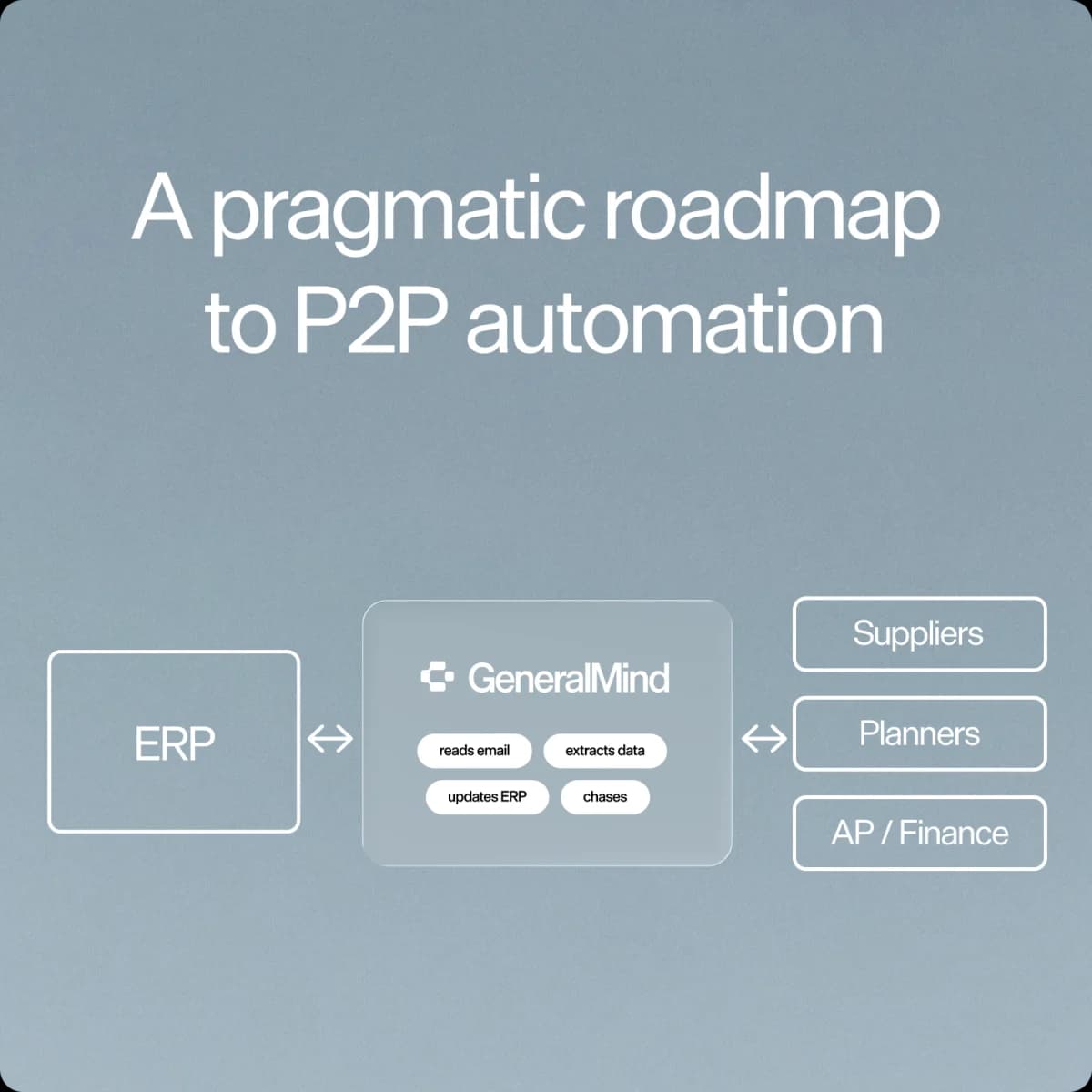
GeneralMind is an AI System of Action that handles repetitive operational work in procurement, supply chain, and finance directly inside a company's existing ERP. It covers both Procure-to-Pay and Delivery-to-Collect journeys across 20+ use cases.
Strengths
- Operates directly inside existing SAP (via API, iDocs, or EDI), Oracle, and Microsoft Dynamics with no system replacement, no S/4HANA migration, and no large IT project required
- Covers both Procure-to-Pay (POs, invoice processing, three-way/four-way matching, AP/AR) and Delivery-to-Collect (order intake, confirmations, shipping coordination, claims handling) across 20+ use cases
- Confidence-based processing with human-in-the-loop: reads unstructured documents and emails in any layout, acts in the ERP, and routes low-confidence cases to a person instead of failing silently
- EU-hosted, ISO 27001 and SOC 2 Type 2 certified, with a full audit trail consolidating operational information otherwise spread across inboxes
Weaknesses
- Consultative enterprise sales model with no self-serve option; not suitable for small businesses or teams seeking rapid self-onboarding
Best for
Mid-sized and large enterprises, particularly those in distribution, wholesale, and manufacturing, that need to automate email-heavy purchase order workflows and invoice processing without replacing their ERP.
9. Stampli
Overview
Stampli is an AI-powered AP automation and procure-to-pay platform that embeds into a company's existing ERP workflows to automate invoice processing, PO matching, approvals, vendor management, and payments without requiring ERP reconfiguration.
Strengths
- ERP-first architecture integrates with 70+ ERPs and accounting systems including SAP, Oracle, NetSuite, QuickBooks, and Microsoft Dynamics without ERP reconfiguration
- Stampli AI automates the majority of AP work across a large number of fields, with all entries reviewed by humans before ERP posting
- 2-way and 3-way PO matching supporting partial deliveries, split POs, and line-level matching, plus ACH, check, wire, virtual card, and international payments
- Named a G2 Leader in Procure-to-Pay and AP Automation in Summer 2026
Weaknesses
- P2P scope is narrower than full S2P suites: strategic sourcing, contract lifecycle management, and advanced spend analytics are not included
- Procurement module (purchase requests and PO creation) is more basic compared to purpose-built procurement platforms; best suited for AP-led buying organizations
Best for
Mid-market finance and AP teams seeking fast ERP-integrated invoice automation without a full platform replacement.
10. Procurify
Overview
Procurify is a mid-market agentic procurement and procure-to-pay platform covering the full intake-to-pay cycle: purchase requests, approvals, PO creation, receiving, invoice matching, and payments in one connected system.
Strengths
- Ranked #1 Mid-Market Procure-to-Pay on G2 Summer 2026; deploys in weeks with no engineering resources required
- Full intake-to-pay workflow: structured purchase requests, configurable approval routing, automatic PO creation, mobile goods receipt, invoice matching, and payment
- Native ERP integrations with NetSuite, QuickBooks Online, Sage Intacct, and Microsoft Dynamics 365; PunchOut catalog support including Amazon Business
- Transparent per-user pricing tiers (Starter, Business, Premium) making budgeting straightforward for mid-market buyers
Weaknesses
- Not designed for enterprise-scale complexity: organizations with intricate multi-ERP landscapes, global supply chains, or direct procurement needs will outgrow the platform
- Strategic sourcing, contract lifecycle management, and supplier risk management are limited compared to full S2P suites
Best for
Mid-market finance and operations teams in healthcare, education, biotech, manufacturing, and non-profits seeking fast time-to-value.
Methodology: how we ranked these P2P platforms
Each platform was evaluated across five dimensions: feature breadth (purchasing, invoicing, supplier management, analytics), ERP integration depth, implementation effort, company size fit, and total cost of ownership. We weighted real-world suitability over raw feature count. A platform with deep SAP integration matters little to an Oracle shop, and a tool that deploys in weeks offers more practical value to a mid-market team than a suite requiring a six-month rollout.
The ranking reflects a balance of these factors rather than a single score. Organizations with comprehensive P2P systems report 20-25% reductions in procurement operating costs, 30-40% decreases in cycle times, and achieve positive ROI typically within 18-24 months of deployment (Persistence Market Research). Those benchmarks hold only when the platform matches the buyer's operational reality, which is why alignment with ERP ecosystem and team capacity mattered more in our evaluation than any single capability.
Key takeaways
- Start your shortlist by matching the platform to your ERP ecosystem: SAP Ariba for SAP shops, Oracle Fusion for Oracle environments, and ERP-agnostic options like Ivalua or Stampli when you run a mixed landscape.
- Weigh implementation timeline against feature depth; a platform that takes six months to deploy can cost more in delayed value than a narrower tool that goes live in weeks.
- Consider autonomous, AI-driven automation for email-heavy procurement workflows (PO follow-ups, invoice matching, supplier confirmations) where routine tasks consume the most staff hours.
- Evaluate total cost of ownership beyond subscription fees: factor in implementation services, training, ongoing admin, and the cost of workarounds if the platform doesn't fit your processes.
- Run a structured pilot with two to three finalists before committing; adoption by non-finance users is the single best predictor of whether a P2P platform delivers its promised ROI.
Conclusion
The right procure-to-pay platform in 2026 comes down to four variables: your ERP ecosystem, the complexity of your spend, the size of your procurement team, and how much automation you're ready to adopt. Enterprise SAP and Oracle environments have clear native options. Organizations running mixed or legacy ERPs benefit from ERP-agnostic suites or AI-first tools that layer on top of existing systems. Mid-market teams should prioritize deployment speed and user adoption over feature depth.
Rather than selecting on feature lists alone, shortlist two to three platforms that align with your operational reality, run a structured pilot focused on your highest-volume workflow, and measure adoption by the people who actually submit purchase requests and process invoices. That approach turns a software decision into a measurable operational improvement.
Frequently Asked Questions
Map each step from requisition through payment, identify manual handoffs (email approvals, spreadsheet tracking, paper invoices), and select a platform that automates those handoffs within your existing ERP. Start with the highest-volume pain point, usually invoice processing or PO creation, prove ROI there, then expand. In one 2024 study, organizations with mature AP pipelines took roughly three days to complete an invoice, compared to the 17-day average, and processed each invoice at less than a quarter of the cost (IBM).
SAP Ariba is the native choice for PO automation within SAP. It handles guided buying, catalog-based ordering, and automated invoice matching against POs. Organizations that want to layer autonomous PO follow-up and unstructured email handling on top of legacy SAP without migrating to S/4HANA also look at AI-first tools that connect via standard SAP interfaces (APIs, iDocs, or EDI).
Platforms with confidence-based AI processing can read supplier emails, extract order confirmations, match them to open POs, and act in the ERP without manual intervention. The key differentiator is whether the tool handles unstructured communication (free-form emails, varied PDF layouts) or only structured, template-based documents. Look for human-in-the-loop designs that route low-confidence cases to a person rather than failing silently.
Add up subscription fees, implementation services, internal IT effort, training, and ongoing administration. Then estimate the cost of workarounds: if the platform can't handle your approval logic or ERP integration natively, you'll pay for middleware, custom development, or manual intervention. Small and medium-sized enterprises are showing strong investment momentum, with procurement technology spending expected to grow roughly 50% between 2020 and 2025, so getting TCO right upfront avoids costly re-platforming later.
AI now automates invoice coding, PO matching, spend anomaly detection, and even supplier communication. Teams adopting generative AI have observed improvements reaching up to 10% across productivity, effectiveness, and user experience, with some cases exceeding 25%. Yet 64% of procurement leaders expect AI to transform their roles within five years, which means the technology is still early. Prioritize platforms where AI augments existing workflows rather than requiring you to rebuild processes from scratch. For a deeper look at AI procurement platforms, evaluate how each handles unstructured data and autonomous decision-making.