Build vs. Buy: AI Purchase Order Automation in 2026
You can build AI purchase order automation in-house, and for a genuinely unique, core-differentiating workflow it can be the right call. For standard PO and order processing, buying is usually faster and roughly 80% cheaper once hidden costs are counted. The hard part isn't the demo. It's reaching reliable 90%+ autopilot and keeping it there. This guide lays out the real trade-off, including when building actually makes sense.
The biggest "competitor" for any automation vendor isn't another vendor at all: it's "we'll build it ourselves." It's a reasonable instinct with modern models. Here's the honest math.
What follows is how to run the build vs buy AI automation decision on your own numbers: how to size the work before you commit to it, which costs get left off the sheet, and the conditions under which building AI purchase order automation yourself is the better answer. The order matters. Most teams pick a side first and cost it afterwards.
The demo is easy; the last mile is where projects die
Standing up a proof of concept that reads a clean PO is quick. Reaching reliable 90%+ autopilot is not. The last mile is edge cases, exceptions, format variability, the supplier who writes the delivery change in paragraph three. Crossing it takes quarters of iteration across model selection, evaluation loops, workflows and integrations. Most internal projects run out of runway before they cross it, and the ones that ship become something a team has to keep alive forever.
How to size the last mile before you commit
There is a cheap way to find out how long your last mile is. Export every order document that arrived in the shared mailbox over one month and sort it into three piles: clean and machine-readable, readable but needing a lookup against master data, and cases where somebody had to write to the supplier before anything could be booked. The first pile is what a two-week prototype handles. The second and third are the project. If the tail is a quarter of your volume, that quarter is where the quarters of engineering go, and where today's manual hours sit, so it is the only part worth automating.
The model was never the hard part. The harness is
Teams often assume they need better AI. But the models crossed the reliability threshold for multi-step work and are now largely interchangeable. What separates a demo from production is the harness: the engineering that decides what context the model sees, how it accesses master data, how output is governed, and how it learns. That discipline is barely a year old as a named practice; few teams have built it, and fewer have operated it at enterprise scale. Building it from scratch is the real project you'd be signing up for.
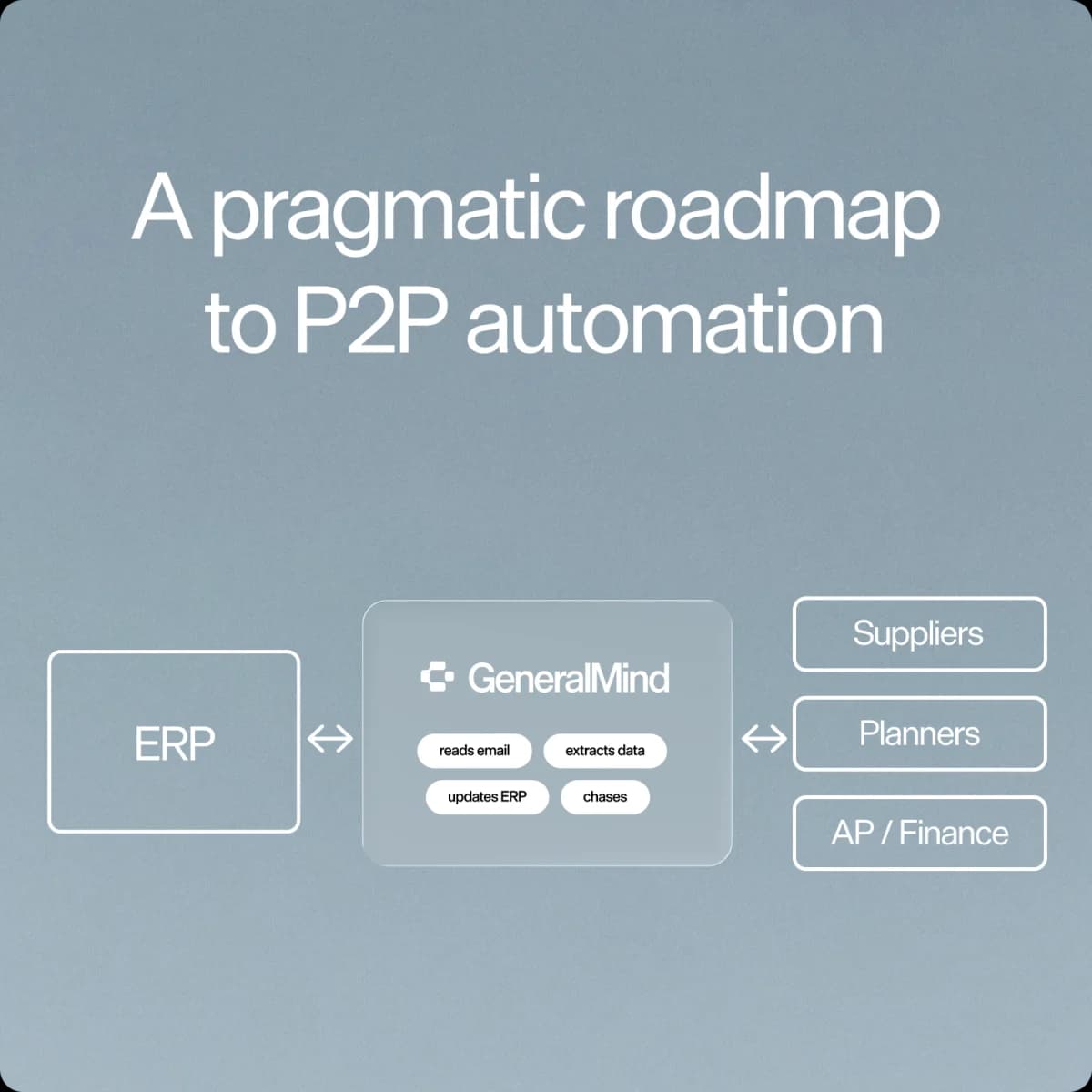
One question makes the harness concrete: who owns it in year three? Not who writes it, but who is on call when a supplier switches billing systems overnight, who owns the automation rate when it slips two points, and who answers the auditor about a wrong booking. On a bought system those names sit with the vendor. GeneralMind connects over your existing mailbox plus a lightweight API, adapts to the interfaces each system already exposes, and maintains them itself. On an internal build every one of those names is on your org chart, and stays there. That is the part of purchase order automation software no build estimate contains, because it isn't a feature. It's a standing commitment.
The cost comparison, honestly
In-house builds look cheaper on paper because the paper leaves things off: senior engineering time, the multi-quarter timeline, ongoing maintenance, and the cost of every failure and accuracy drop once it's live. Counting those, a bought solution typically comes out around 80% cheaper. And with outcome-based pricing you pay per processed transaction, starting only at go-live, so you carry no execution risk during the build. A brittle internal system, by contrast, becomes your responsibility the day it ships.
Build the comparison on your own transaction volume
Both options compete against the cost of doing the work by hand, so start there. Take the order transactions your team touched last month and multiply by your fully loaded cost per touch. Manual supply-chain touchpoints commonly run $30–50 once the clerk, the query email, the rework and the escalation are all counted. That figure is the ceiling on any procurement automation cost either option can justify. It is usually larger than either sheet suggests, because nobody bills for the four minutes spent working out which PO line a confirmation refers to.
Where the enterprise AI ROI case usually breaks
Internal ROI models tend to compare the marginal cost of an API call against a clerk's hourly rate and conclude that building is nearly free. The error is the time axis. Every month the build is not live is a month of savings you don't get, and across a multi-quarter timeline that forfeited period is often worth more than the build itself. Run the enterprise AI ROI case as a cash flow over twenty-four months instead of a per-transaction unit cost and the two options stop resembling each other.
One entry on the buy side is worth reading closely. Outcome-based pricing starts at go-live, is charged per processed transaction, and carries a shortened notice period in the first three months. If the automation rate doesn't materialise, you stop paying and walk. An internal build has no equivalent exit: the sunk cost is your own payroll.
What you can't shortcut
Every live deployment produces operating experience, golden datasets and memories that only accumulate. A bought platform tuned across ~20 enterprise order-intake deployments on SAP starts where your internal build would finish (if it finished). That head start isn't buyable or copyable; it's earned in production.
Volume is part of what accumulates. Oatly runs around 2,500 orders a month through this path with 80% on Autopilot; Klöckner books 81% of order lines with no human edit across 150 suppliers and more than 1,100 PO lines a week. Those are outputs of the curve rather than its starting point: deployments typically land near 85% straight-through on day one, reach 93–95% within weeks, and pass 90% autopilot in roughly six weeks. An internal build starts that climb at zero, with your own inbound as its only signal.
When building in-house is the right call
To be fair to the build case: if the workflow is genuinely unique, is a core competitive differentiator, and you have abundant, dedicated ML and engineering capacity you're willing to commit for years, building can make sense. You keep full control and the IP. The test is honest: is this workflow actually differentiating, or is it standard PO/order processing that hundreds of enterprises run the same way? If it's the latter, buying frees your best engineers for the problems that are genuinely yours.
Two more situations sit squarely in the build column. The first is structured input you already control: if orders arrive as EDI from four long-standing partners, or through a portal you own, there is barely a last mile to cross and the AI part of in-house AI automation shrinks to something a small team can carry. The second is a process still being invented: when the rules change every second week, no vendor contract or roadmap moves at that speed, and a script your own team can rewrite on a Tuesday is the better tool.
What a fair build estimate looks like
If you build, make the estimate honest before you commit. Scope it to the autonomy rate you actually need rather than to a working demo, because the distance between those two is the whole project. Require the evaluation set to exist before the first line of code: a few hundred of your own documents with the correct answer attached. Without it nobody can tell you whether this week's version got better or worse. Then name the owner for year three, in the org chart, with the maintenance load written into the job. Estimates rarely survive that third requirement.
A decision checklist
- Is this workflow a competitive differentiator, or standard operational plumbing?
- Do we have senior ML/eng capacity to commit for multiple quarters, and to maintain it indefinitely?
- Can we tolerate the time-to-value of a multi-quarter build vs. weeks to go live?
- Have we costed the last mile and ongoing maintenance, not just the demo?
- Who owns it, and the audit trail, when the person who built it leaves?
Run it as a bake-off, not a business case
The AI build or buy argument usually gets settled in a slide deck, which is the wrong venue. Give the internal team a four-week spike and the vendor a pilot on the same month of real mail, then compare one number: the share of transactions that reached the ERP with no human touch. Extraction accuracy is not that number, and comparing on it is how teams talk themselves into a build. Two supporting measures are worth collecting: the time from a document arriving to a booking, and who fixed the first three failures and how long it took them. A spike that clears your bar on the full inbound, not the clean subset, has earned the decision.
Frequently Asked Questions
The model is the cheap part. The harness, the last-mile accuracy work and the ongoing maintenance are where cost and risk concentrate.
Reliable 90%+ autopilot typically takes multiple quarters across AI, evaluation, workflows and integrations. A proven platform goes live in weeks.
Outcome-based pricing: costs start only at go-live, you pay per transaction, and a short early notice period means the vendor can be dropped quickly if it doesn't perform.
When the workflow is genuinely unique and core to your differentiation, and you have dedicated capacity to build and maintain it for the long term.
Start with the manual baseline both options are competing against: last month's transaction count times your fully loaded cost per touch, which for manual supply-chain touchpoints commonly runs $30–50. Then model 24 months of cash flow rather than a per-transaction unit cost, so the months a build spends not yet live appear as forfeited savings instead of vanishing from the sheet.
Yes, and it is the cheapest way to decide. Run an internal spike and a vendor pilot on the same month of real inbound documents, then compare the share of transactions that reached the ERP untouched by a person. Judge both on the full mailbox, not the clean subset, which is where prototypes look finished.