6 Best AI Purchase Order Management Platforms in 2026
The deciding question is whether a platform acts on the messy supplier emails, PDFs and Excel files that never match your ERP, or only reads clean structured data. GeneralMind is built for autonomous, end-to-end PO handling with EU data residency; UiPath fits fragmented multi-system stacks, GEP SMART and Zycus fit teams buying a full source-to-pay suite, and Netfira and Parseur fit narrower document-extraction needs.
Managing purchase orders across email threads, supplier confirmations and ERP systems takes more time than it should. If your team still copies PO details by hand or chases suppliers for updates, the problem usually isn't capacity — it's repetition. This guide compares six leading platforms for PO workflow automation, ERP integration and approval automation, with a comparison table and selection criteria at the end.
Manual PO handling carries a cost that rarely shows up on one line item. A single purchase order transaction handled by hand runs $30–50 once you count data entry, chasing suppliers and correcting mismatches, and a mid-sized procurement team processes thousands a month. The platforms below attack that cost from different angles: some extract data faster, others take the decision off your team entirely.
How we evaluated AI purchase order platforms
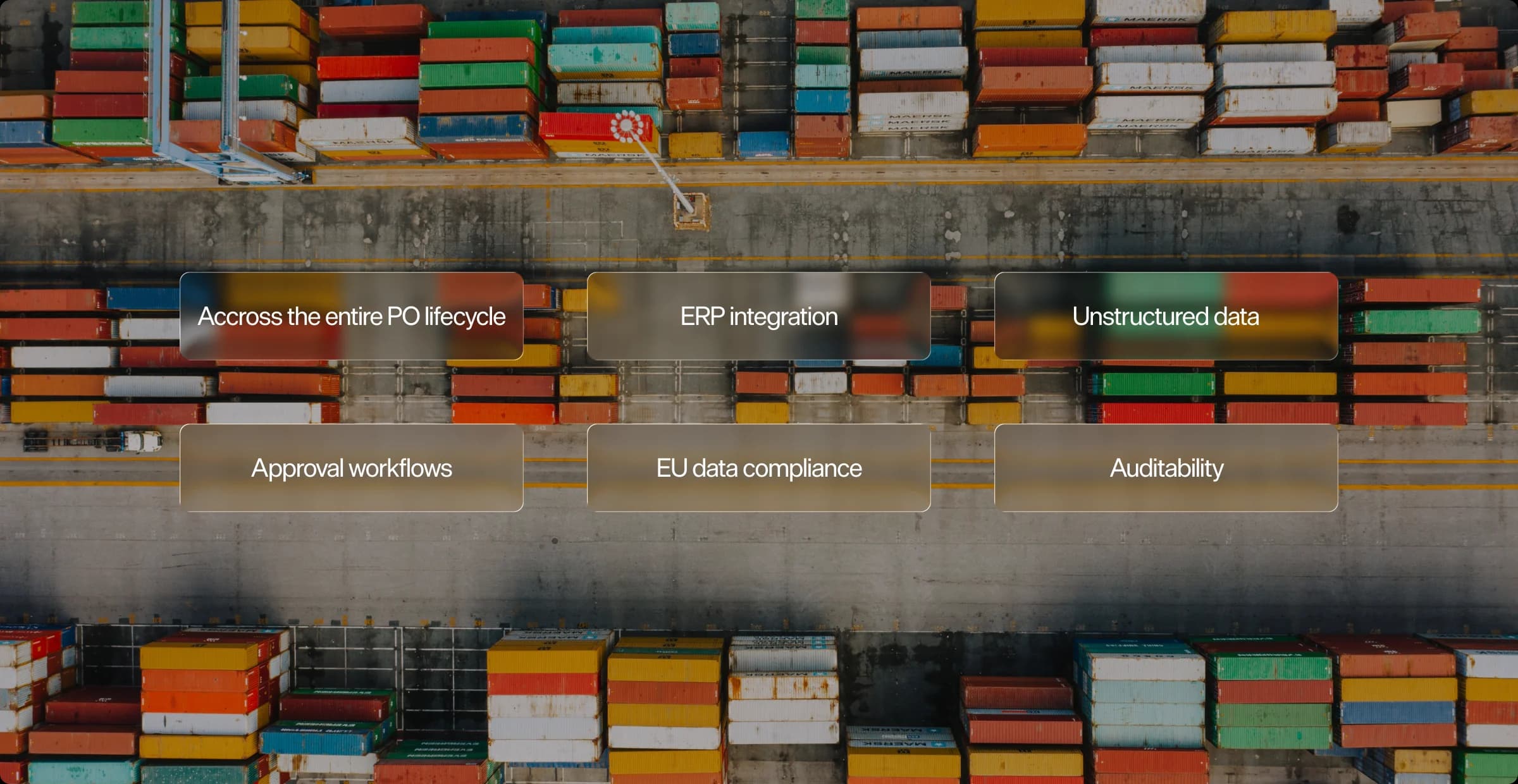
We scored each platform on the work procurement teams actually do:
- PO lifecycle automation — tracking orders from creation through delivery, including confirmations, changes and delays, without manual follow-up.
- ERP integration depth — direct, bi-directional sync with SAP, Microsoft Dynamics, Oracle and other systems.
- Unstructured data handling — reading supplier emails, PDFs and spreadsheets in any format.
- Approval workflow flexibility — configurable routing and confidence-based escalation.
- EU data compliance — GDPR, ISO 27001 and EU data residency.
- Auditability — a clear trail of every action and decision.
The gap between tools shows up on the first three criteria. Most purchase order management software reads a clean PDF and drops the fields into a form; far fewer act on what they read — matching a confirmation to the right line item, deciding whether a two-day delivery slip warrants a supplier email, and booking the result without a person retyping it. The remaining criteria decide whether a tool survives contact with a European procurement environment: bilingual supplier email, heavily customized SAP, and GDPR obligations that rule out sending order data through a US-hosted model.
The 6 best AI purchase order management platforms
1. GeneralMind — best overall for autonomous PO management
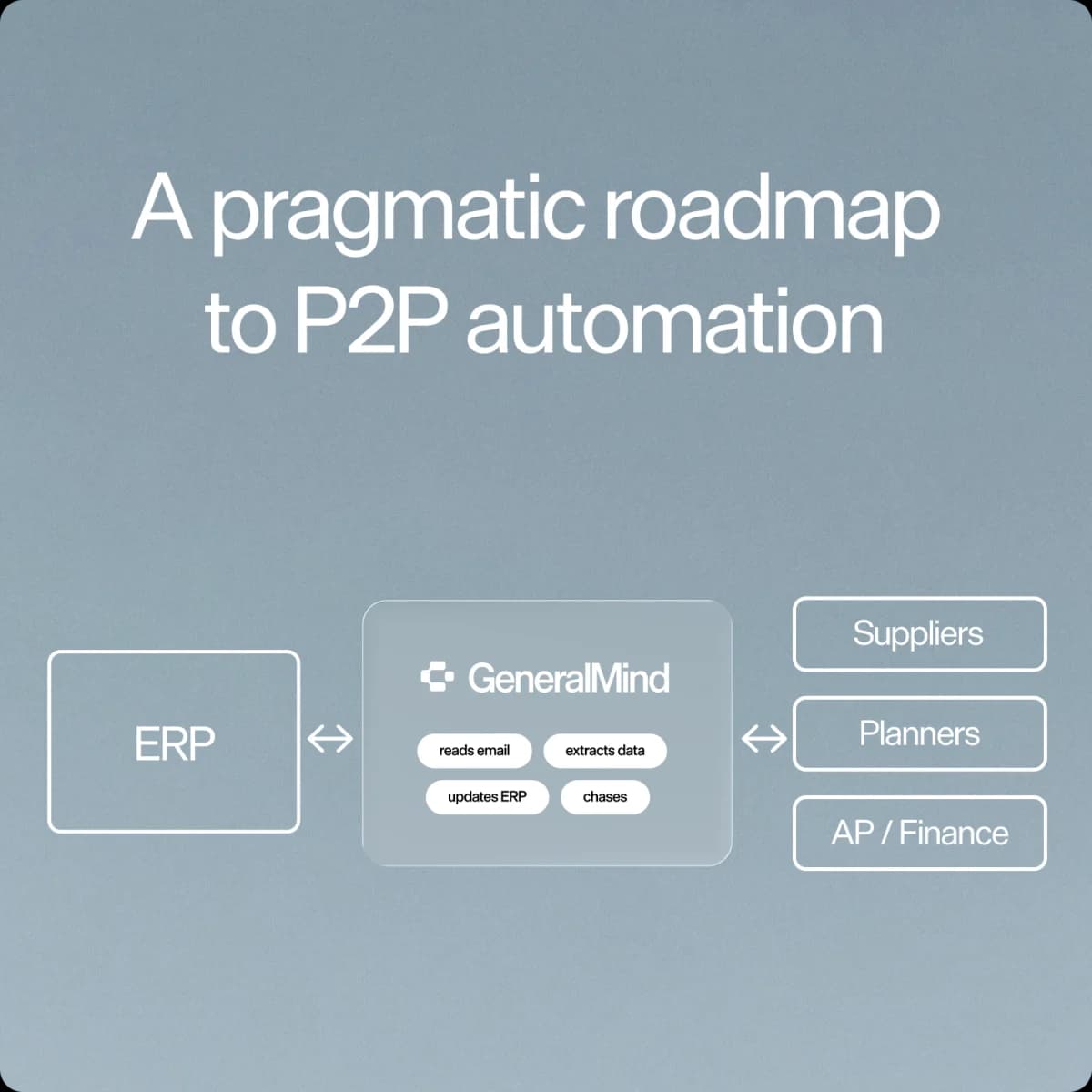
GeneralMind puts AI Employees on top of your existing mailbox and ERP to run the communication-heavy PO work end to end: it reads confirmations and delivery updates in any format, fuzzy-matches them to the right POs and line items, books to the ERP and follows up with suppliers when information is missing. Routine cases run on autopilot; every uncertain case escalates to your team with a pre-drafted response. At Klöckner, 81% of order lines are booked with zero human edits across 1,100+ PO lines a week. Every operator correction becomes permanent system knowledge, so accuracy compounds with use. Hosted in Europe (ISO 27001:2022, ISO 27701, SOC 2 Type II) with outcome-based pricing that starts only at go-live.
Best for: enterprises that want the decision layer automated, not just document extraction.
2. UiPath — RPA for fragmented procurement stacks
UiPath automates PO generation, requisition routing and 2- and 3-way invoice matching through configurable bots, and works well when your process spans systems that don't natively connect. Its Document Understanding module adds machine-learning extraction on top of the bots, so it reads semi-structured documents rather than only clicking through screens. The trade-off is ownership: someone builds and maintains bot logic per workflow, and rule-based flows break when a supplier changes a PDF layout or replies by email instead of using the expected channel. Teams often end up maintaining the automation instead of gaining time from it.
Best for: organizations standardizing highly fragmented, multi-system processes.
3. GEP SMART — full source-to-pay suite
GEP SMART covers sourcing, contracts, supplier management, invoicing and payments with AI modules for spend analysis and risk. PO processing is one module inside a much larger source-to-pay platform built for category management and strategic sourcing. That breadth pays off if you're consolidating procurement into a single system; it's heavier than needed for teams focused purely on operational PO automation. Implementations run in quarters, not weeks.
Best for: large enterprises wanting one strategic S2P platform.
4. Zycus — cognitive AI across S2P
Zycus offers a full S2P suite with its Merlin engine for spend classification and document analysis, plus conversational intake via Microsoft Teams. Merlin classifies spend and flags anomalies, and the assistant surfaces recommendations rather than acting on them, so a person still approves and books most transactions. AI depth is maturing and implementations tend to run 6–12 months.
Best for: mid-to-large enterprises wanting single-vendor S2P.
5. Netfira — document automation for confirmations & ASNs
Netfira automates PO confirmations, order changes and advance shipping notices, extracting data and matching it back to orders. It reads confirmation and ASN formats that arrive outside EDI — document types many procurement automation tools overlook — and pushes structured data to the ERP. It stops at document automation rather than full workflow orchestration: deciding what to do with a mismatch, and following up with the supplier, still sits with your team.
Best for: teams with high volumes of supplier confirmations outside EDI.
6. Parseur — OCR-based data extraction
Parseur turns emails, PDFs and spreadsheets into structured data with custom field mapping and API forwarding. You define a template or let its AI detect fields, and it forwards clean data to whatever system you connect. Low-code and fast to deploy, it extracts only — no approvals, budgets, matching or full PO workflow — so it works as a feeder into another automated purchase order system rather than as one itself.
Best for: augmenting an existing system with flexible extraction.
Comparison table
| Platform | Unstructured email/PDF | Autonomous supplier follow-up | EU data residency |
|---|---|---|---|
| GeneralMind | |||
| UiPath | |||
| GEP SMART | |||
| Zycus | |||
| Netfira | |||
| Parseur |
Where GeneralMind fits
Most PO tools stop at structured data or require suppliers to use a portal. The real work — reading emails, understanding intent, chasing missing information — still lands on your team. GeneralMind takes on that operational layer: it monitors the inbox, tracks every PO conversation, keeps the ERP current, and follows up autonomously. For German and European enterprises it meets strict requirements with ISO 27001:2022, ISO 27701 and SOC 2 Type II certifications and EU data residency, and pricing is per transaction — you pay for outcomes, not seats or licenses.
The engineering around the model matters more than the model here. InboxIQ classifies each incoming message, vision-language extraction reads any document layout, and context-based fuzzy matching resolves a supplier's part number to the right ERP entity. A deployment that books around 85% of cases correctly on day one reaches 93–95% within weeks as it learns your master data, and the share running fully on autopilot passes 90% in roughly six weeks — the pattern across deployments, not a fixed guarantee. Every operator correction becomes permanent system knowledge, so accuracy compounds instead of plateauing.
Matching a platform to your situation
No single tool wins for every procurement team. If your process spans disconnected systems and you have RPA developers in-house, UiPath standardizes it. If you're buying one strategic source-to-pay suite for a global category team, GEP SMART or Zycus cover far more than PO work. If you only need clean fields out of confirmation PDFs, Parseur or Netfira do that at low cost. GeneralMind fits when the bottleneck is the communication itself — the supplier emails, the confirmations that don't match, the follow-ups — and you want that decided and booked without adding headcount.
Frequently Asked Questions
Software that uses AI to read, track and process purchase orders. At the autonomous end of the category, a platform reads supplier communications in any format, matches them to ERP records, and keeps PO data current automatically.
Yes. GeneralMind connects to SAP, Oracle, Microsoft Dynamics and 100+ systems via a lightweight API, with bi-directional sync — no migration required.
Full S2P suites typically take 6–12 months. GeneralMind goes live in weeks and reaches 90%+ autopilot in roughly six weeks as it learns your data — typical experience across deployments, not a fixed guarantee.
ISO 27001, SOC 2 Type II and GDPR at minimum. GeneralMind adds ISO 27701 and EU data residency (hosting in Frankfurt, DR in Stockholm).
A manually handled PO transaction runs roughly $30–50 once you count data entry, chasing suppliers and correcting errors. Teams that move the routine cases to an automated purchase order system typically reclaim about 60% of manual order-processing time within the first three months.
OCR and document extraction read fields off a page and hand them back for a person to check and book. Purchase order automation software at the autonomous end matches the data to the right PO line, decides whether it clears your rules, books it to the ERP, and escalates only genuine exceptions with a drafted reply.