How German Manufacturers Choose AI PO Software

German manufacturers should evaluate AI purchase order software on five dimensions: does it automate decisions or just extract data, how it learns from corrections, ERP integration depth, compliance and data residency, and the commercial model. The tools that win handle the unstructured supplier communication your ERP can't see, and they get more accurate the more you use them.
Your team is skilled and your SAP is configured, but capacity leaks into work that requires no skill: matching PO confirmations, chasing delivery dates, reconciling invoices. Here's how to evaluate AI PO software so you buy an autopilot, not another tool to maintain.
AI purchase order automation covers two products that look identical in a slide deck: one reads a document and hands you fields, the other finishes the transaction. The factors that matter when choosing PO automation software are fewer than most RFP templates suggest. Bring the person who clears your exception queue to every demo. They know which dozen suppliers cause half the work, and they ask sharper questions than the steering committee.
1. Decision layer, not document layer
OCR and RPA turn documents into data and stop; the decision (which supplier, which material, which price, what to do when something's missing) still happens in someone's head. Evaluate whether the software automates the decision: fuzzy matching against master data, drafted clarifications, ERP booking, all with a confidence score and clear escalation. This is the single biggest differentiator.
The test is cheap to run. Give the vendor an unseen confirmation that covers four of your POs, uses the supplier's own article codes, and cancels position three in a free-text line halfway down the page. Then watch where the demo stops. If it stops on a review form with fields highlighted for someone to confirm, you are buying purchase order management software and keeping the work. If it stops on a booked line plus a drafted email about position three, you are looking at a different product.
Ask for the touch rate from a live production tenant: what share of order lines completes with no human edit at all. GeneralMind books 81% of order lines at Klöckner with zero human edits, across 150 suppliers and 1,100+ PO lines a week; at Oatly, roughly 80% of about 2,500 orders a month run on Autopilot.
2. How it learns
The underlying models are becoming interchangeable; what separates a demo from production is the harness: how the system decides what context the model sees, accesses master data, controls output, and learns. Ask how operator corrections become permanent knowledge. In GeneralMind's loop, each correction builds golden datasets that become memories the system applies from then on, so accuracy compounds with use.
Ask where a correction goes. If someone on the vendor's side adds a rule, you have bought a configuration backlog with a model in front of it; if the answer is a quarterly retrain, your fix waits a quarter. What you want to hear is that an operator's edit on Tuesday changes behaviour on Wednesday, on that supplier and on the ones that resemble it.
Then ask the uncomfortable follow-up: how does the vendor know last week's fix didn't break something that already worked? Without an evaluation set they can point to, your team is the test suite. You find that out in month four, when a supplier who used to run clean starts appearing in escalations.
3. ERP integration depth
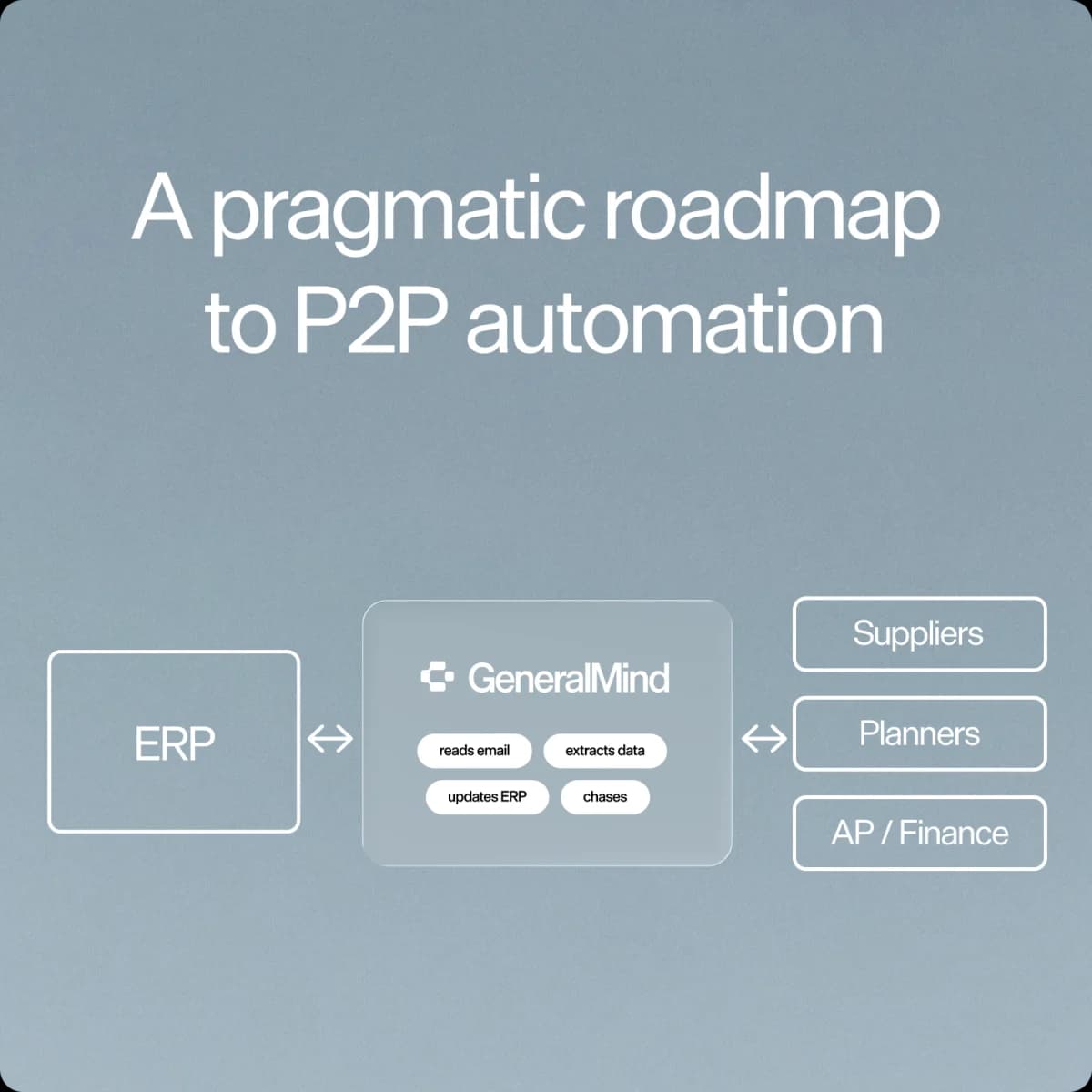
German manufacturers can't rip out years of SAP configuration. Evaluate whether the tool works as a layer on top of your existing systems, writes back bidirectionally, and supports heavily customized environments. GeneralMind connects over your mailbox and a lightweight API to SAP (ECC and S/4-ready), Oracle, Dynamics and 100+ systems, and owns the integration layer over time.
Few German manufacturers run a single ERP: ECC in the main plant, S/4 at a newer site, Dynamics at a company acquired four years ago. Ask whether one workflow covers all of it, because manufacturing workflows rarely stop at a system boundary: a confirmation for a plant in Poland can move a production date in Germany.
Who maintains the interface in month nine?
Integration demos well and is expensive to keep. Ask who does the work when a Z-field moves or a site upgrades. If the answer routes through your own SAP backlog, price that in. Every field change becomes a ticket, and the automation degrades while it waits. GeneralMind adapts to the interfaces each system already exposes and maintains them itself, with no migration to schedule.
4. Compliance and auditability
Require EU data residency, ISO 27001, ISO 27701 and SOC 2 Type II, plus a full audit trail. Ask where hosting sits and whether your data trains third-party models. GeneralMind hosts in Frankfurt with DR in Stockholm, keeps data isolated and untrained, and logs every action for compliance review. That is more than the status quo, where reasoning lives in people's heads.
Read the scope, not the logo. An ISO 27001 certificate covers a named entity and a named set of systems on a named date. Ask for it and check that the service you are buying sits inside the scope statement. Ask separately where inference runs: a database in Frankfurt helps nobody if every document is posted to a model endpoint in Virginia.
On the audit trail, ask to see one line. Internal audit will pick an order line from March and want to know why a nine-day delivery slip was accepted, under which rule, and whether a person overrode anything. If that needs a support ticket to reconstruct, the logging is for the vendor's engineers, not your auditors.
5. The commercial model and time to value
Watch for implementation fees, license lock-in and multi-quarter rollouts. Outcome-based, per-transaction pricing turns a fixed labor-cost block into a variable, output-based model and aligns incentives. GeneralMind charges only per processed transaction, costs start at go-live, and deployment runs in weeks. The first three months carry a shortened notice period as a de-risking term.
Per-transaction pricing means little until the transaction is defined. Is a confirmation covering fourteen lines one transaction or fourteen? Does a follow-up email in the same case count again? Get the counting rule in writing and have the vendor price last month's actual volume against it. Then press the exit as hard as the rate: what does it cost you to walk away in month two if the numbers don't hold?
What to put in front of a vendor
Onboarding needs 30 to 50 representative transactions, plus your schema and enough process context for the system to know which rules bind. The instinct is to send clean examples. Don't. Send the confirmation that took three emails to resolve, the Excel order with merged cells, the supplier who quotes their own order number and never yours.
Name the operator before the pilot starts and give them a confidence threshold they own. Procurement software evaluations rarely stall on the technology; they stall because nobody decided who works the escalations, so exceptions collect in a queue with no owner and the pilot reads as a failure. Start the security review in week one too. A DPA and a certification scope take a fortnight to clear most German legal departments, and they move go-live dates more often than accuracy does.
A note on realism
Be cautious of instant "95% accuracy from day one" claims. The last mile of edge cases is where most projects fail. A credible path starts around 85% straight-through on day one (from pre-training on similar workflows), rises to 93–95% within weeks, and reaches 90%+ autopilot in roughly six weeks. Ask any vendor for demonstrated production numbers, not slideware.
The failure nobody plans for is a curated dataset, usually assembled in good faith. Whoever prepared the sample chose documents that were legible and complete, because those were easiest to export. Production sends the scanned fax, the confirmation missing pages two and three, the email whose entire content is "wie besprochen, siehe Anhang" with no attachment.
An accuracy figure without a denominator is the next trap. Ninety-five percent of what? Fields, lines, documents, or complete cases from inbox to booked ERP line? Field accuracy is the flattering measure, and it collapses on a fourteen-line confirmation carrying forty values: at 95% per field, most documents contain an error, and one wrong line is a wrong booking.
Accuracy and autonomy also get treated as one number. A system can be right almost every time and still route most cases to a person, because its thresholds sit low. Accuracy tells you whether to trust an answer; autopilot share tells you how much work actually left your team, which is the operational efficiency you are paying for. Around 60% of manual processing time reclaimed in the first three months is worth testing against your own baseline, a number most teams measure for the first time during the evaluation.
Expect a curve, not a switch. The distance between 93% and the last few points is weeks of corrections on your suppliers, your material master, your tolerance rules. A vendor promising day-one perfection is describing a narrower problem than yours.
Frequently Asked Questions
You can build, but reaching reliable 90%+ autopilot takes multiple quarters across AI, evaluation loops, workflows and integrations. Every failure becomes your ongoing responsibility. Outcome-based software shifts that complexity and risk to the vendor.
Usually 30–50 representative real-world transactions including edge cases, plus your system schema and process context. Shared securely via exports, sample files or controlled access.
Yes. GeneralMind is built for complex enterprise environments and adapts to the interfaces each system already exposes, across APIs, documents and communication channels, maintaining them itself.
Nothing is written or sent below your confidence threshold; those cases go to an operator. With outcome-based pricing, the vendor is incentivized on correct execution.
At the useful end of the category: reading confirmations, order changes and delivery updates in whatever format they arrive, matching them to the right PO line, checking them against your tolerances, booking the result to the ERP, and chasing what never came back. Purchase order tracking software that only stores and displays status is a different product. It tells you a confirmation is late without doing anything about it.
Two numbers: the share of order lines that complete with no human edit, and how long it takes to close an exception once it reaches an operator. Extraction accuracy predicts neither. Measure your current baseline on the same two before the pilot starts. A comparison against a number nobody recorded is an argument, not a result.