GeneralMind vs Point Solutions for Procurement Automation
Point solutions automate one workflow each: one tool captures requests, another routes approvals, a third runs the supplier portal, a fourth builds the reports. Each does its slice well, and inside that slice a specialist usually beats a generalist. GeneralMind operates across procurement, orders, claims and other back-office workflows from a single context layer, so one record carries an order from first email to booked confirmation. The point solutions vs platform decision is rarely about which tool is better at its own job. It is about the handoffs between them, where nobody's product roadmap lives.
Key takeaways
- A four-tool stack is strong inside each tool and thin between them. Every handoff is a field mapping, and every mapping needs an owner the day it breaks.
- Each tool holds a partial truth about the same order, so "where is this order" means opening four tabs and deciding which to believe.
- Exceptions fall between owners and land in a human inbox, which is where they were before the tools were bought.
- The audit trail splits across four vendors, four log formats and four retention policies, and none records the reasoning behind a decision.
- Point solutions are the right answer when one step is broken, when a specialist is years ahead in its niche, or when a departmental budget is the only budget available.
What a point-solution stack looks like in procurement
A team that bought its way out of manual work one step at a time usually ends up with four or five tools. An intake tool turns free-text requests into structured forms. An approval tool routes them through thresholds, delegations and out-of-office rules. A supplier portal collects confirmations, certificates and price lists. A reporting layer reads whatever the other three write and produces spend and OTIF dashboards.
Every one was bought for a real reason and fixed the thing it was bought for. Intake volume in the shared mailbox drops; cycle time on the approvals the tool can see shortens. That is why most cells in the point-solution column of the matrix read "partial" rather than "no": within its own scope, a specialist performs.
The mismatch is structural. A purchase order is not a step. It is an object that lives for six or eight weeks, passes through all four tools, and changes on the way — a delivery date slips, a line is confirmed at 92% of the quantity, a price moves 3% between order and confirmation. Each tool was built to be the system of record for its step. None was built to be the system of record for the order.
Point solutions vs platform: the cost lands in the seams
Count interfaces, not tools. Four tools that all need to know about the same order do not create four connections; they create connections to the ERP, the mail server, the data warehouse and to each other, so a four-tool stack typically runs five to eight live interfaces. Each is a field mapping, a retry policy, a credential that expires, and a schema that changes when a vendor ships a release you did not schedule.
None of that appears in the four business cases that got the tools approved. It appears afterwards, as a middleware line item, an integration partner's day rate, or an engineer who now spends part of every sprint on procurement plumbing. The failures are also quiet. A webhook payload changes shape, a field starts arriving empty, and 40 POs a week lose their promised delivery date until someone notices the dashboard looks wrong. Nobody gets paged, because no monitoring covers the space between two vendors.
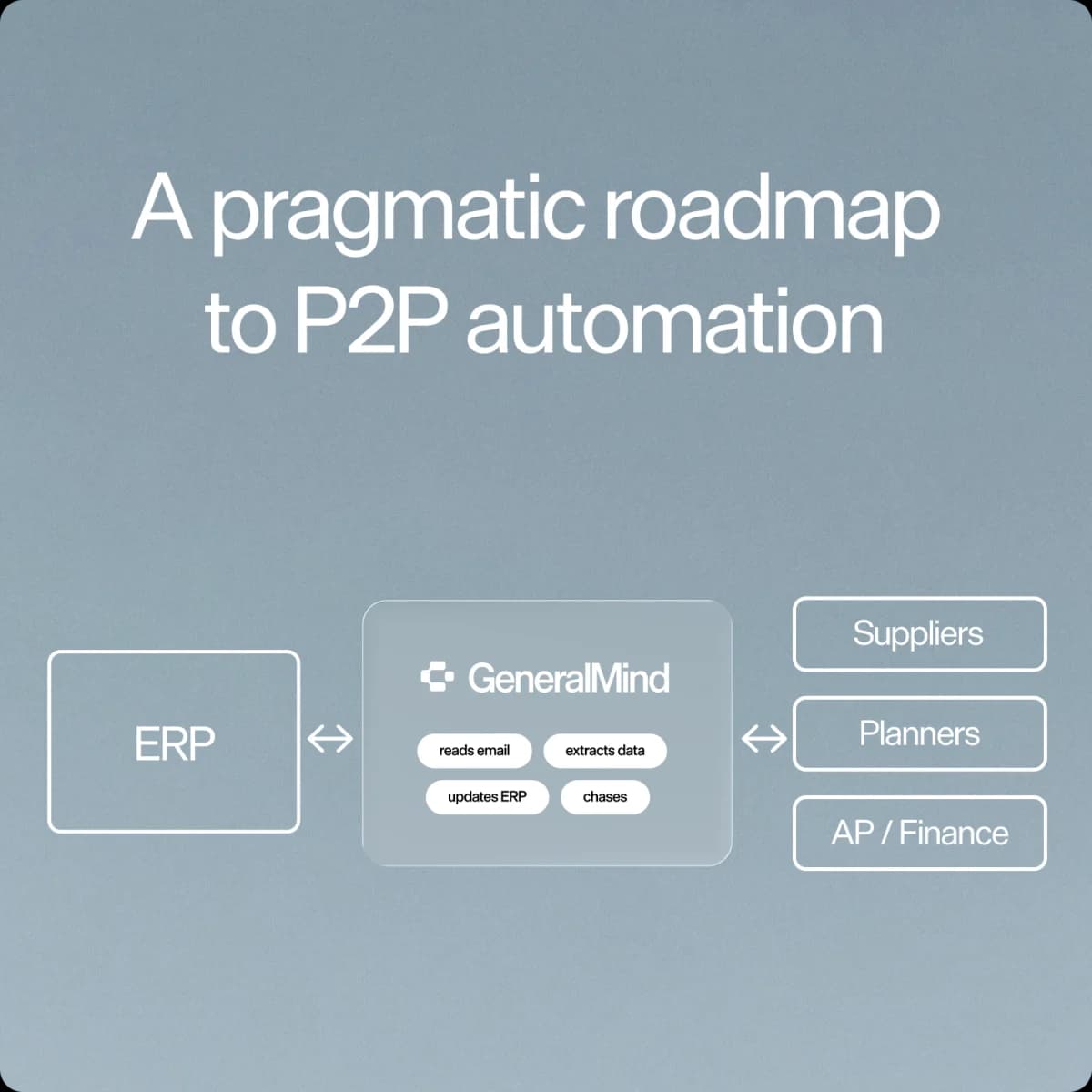
GeneralMind is one connection set rather than a mesh. It reads and writes across the systems already in place — 100+ connected systems spanning ERP, mailboxes, document stores and supplier portals — and the layer that reads a supplier email is the layer that writes the confirmation into the ERP. Go-live is a matter of weeks with no ERP modification, and GeneralMind maintains the interfaces, not your team.
Four systems, four partial truths about one order
Ask a simple question: where is this order. In a point-solution stack the honest answer has five parts. The intake tool knows what was requested. The approval tool knows who signed and when. The supplier portal knows what the supplier last uploaded. The ERP knows what was booked. The reporting layer knows what all of them looked like at last night's sync. When two disagree — and on any order that changed after approval, two will — the reconciliation is manual.
That is how a stack quietly recreates the work it was bought to remove. Someone becomes the person who knows which system to trust for which field, and which mismatches are real rather than a sync artefact. That knowledge sits in a person, not a system, which is why the matrix marks institutional knowledge independence as absent on the point-solution side.
GeneralMind keeps one record per order and treats the supplier email, the PDF attachment, the portal update and the ERP state as inputs to it rather than competing versions of it. At Klöckner, 1,100+ PO lines a week across 150 suppliers run through that single record, and 81% of order lines book with zero human edits. Order status is a lookup, not an investigation.
Who owns the exception when no tool owns the process
Take a concrete case. A supplier confirms 800 of 1,000 units, three weeks late, at a price 3% above the PO. Which of the four tools owns that? The intake tool is done; the request left weeks ago. The approval tool only re-triggers if the PO changes in the ERP, and it has not changed yet. The supplier portal recorded the document and considers the job finished. The reporting layer will surface it next month as a price variance. So the exception lands in a buyer's inbox, unaggregated, alongside forty others.
Split accountability makes it worse when something goes wrong. Each vendor's support desk can accurately state that the failure was outside their scope, and each is telling the truth. The order sits in the gap between two correct answers. Internally the pattern repeats: the owner of the approval tool is not the owner of the portal, and neither owns the mapping between them.
GeneralMind runs the judgment rather than routing around it. Routine cases go through on autopilot; uncertain cases escalate to a named operator with a pre-drafted reply attached, so the human step is a decision rather than a reconstruction. A typical deployment books around 85% of cases correctly on day one, reaches 93–95% within weeks as it learns your master data, and passes 90% autopilot in roughly six weeks.
The audit trail splits across four vendors
Try reconstructing a decision fourteen months after the fact. In a stack that means four log exports in four formats, with four retention windows, four sets of user identifiers and, if you are unlucky, timestamps in three time zones. Two of the four may not expose an immutable log at all, because audit infrastructure is not what a single-purpose tool competes on. And none of them logs what an auditor actually asks for: why the decision went that way, given what was known at the time.
This is where the matrix marks the point-solution column a flat no rather than partial, and a fifth tool does not close it: the reporting layer can only aggregate what the other three chose to emit.
GeneralMind writes one log line for every action, carrying agent ID, timestamp and the reasoning behind the decision, with human overrides tracked as first-class events. Data stays in the EU, hosted in Frankfurt with disaster recovery in Stockholm, under ISO 27001:2022, ISO 27701 and SOC 2 Type II, and GDPR-compliant by design. One export, one format, one retention policy.
Comparison matrix
The matrix scores both approaches across 14 capabilities in five groups. "Partial" carries weight in the point-solution column: it marks the cases where a specialist tool delivers inside its own workflow and stops at the boundary.
| Capability | GeneralMind | Point solutions |
|---|---|---|
| Scalability & Workforce | ||
| Scalable workforce — Expand throughput without proportional headcount growth | ✓ Autopilot operates across all workflows at any volume | ~ Scales one workflow; limited cross-function reach |
| Flexible tool stack — Operate across email, ERP, chat, and document formats natively | ✓ Native connectors across all enterprise tool types | ~ One integration category per solution |
| Scalable exception handling — Resolve edge cases and anomalies at volume without human escalation | ✓ Learns patterns; auto-resolves or routes intelligently | ~ Exception logic in narrow domain only |
| Operational Reliability | ||
| Clean data entry — Structured, validated capture from unstructured inputs at the source | ✓ Validates, transforms, and reconciles data at source | ~ Clean in workflow scope; no cross-system sync |
| Operational compliance — Consistent policy adherence enforced across every transaction | ✓ Policy engine embedded in every automated action taken | ~ Compliance limited to solution scope |
| Accurate ETA synchronisation — Real-time sync of delivery dates, PO status, and supplier data | ✓ Live sync across ERP, email, and supplier portals | ~ Sync limited to specific workflow in scope |
| Early risk detection — Proactive identification of supply disruptions before they escalate | ✓ Pattern-based detection across all live data streams | ~ Risk signals within narrow workflow domain only |
| Audit, Compliance & Accountability | ||
| Immutable audit logs — Tamper-proof records of every decision and system action taken | ✓ Every action logged: agent ID, timestamp, reasoning | ✗ Limited or no audit infrastructure by default |
| Clear accountability buckets — Traceable ownership of every decision across teams and systems | ✓ Agent-level attribution with human override tracking | ✗ Action ownership frequently unclear across systems |
| Data Quality & Intelligence | ||
| KPI-level data generation — Automatic production of procurement performance metrics in real time | ✓ Real-time KPIs generated from every automated action | ~ Metrics limited to the solution's workflow scope |
| Unstructured data processing — Parse and act on emails, PDFs, chat messages, and documents | ✓ Multi-modal understanding across all input format types | ✗ Narrow format support; no general-purpose parsing |
| Institutional knowledge independence — Operate reliably without reliance on individual staff expertise | ✓ Learns and encodes institutional patterns automatically | ✗ No learning or knowledge accumulation over time |
| Implementation & Cost | ||
| Low implementation risk — Deploy without long integration projects or operational disruption | ✓ Live in weeks; no ERP modification required | ~ Scoped integration; manageable deployment timeline |
| Reduced coordination cost — Lower cost per transaction by automating routine manual work | ✓ 70%+ reduction in manual coordination overhead | ~ Reduces cost in specific workflow; cross-function gaps |
| Coverage score | 14 / 14 | 5 / 14 |
Legend: ✓ fully supported · ~ partial · ✗ not supported.
When to choose which: point solutions vs platform
Buy the point solution when exactly one step is broken. If intake and approvals are fine and the only real pain is supplier confirmations arriving as PDFs, a single tool aimed at that step is faster to buy and easier to justify than a platform programme. One problem solved by one tool is not sprawl; it becomes sprawl at the fourth purchase.
Buy the point solution when a specialist is genuinely years ahead in its niche. Category-specific sourcing, tail-spend negotiation and contract redlining are deep problems with deep products behind them, and a broad platform will not match a focused vendor there on a two-year horizon. In those categories the best-of-breed vs platform argument is won on merits, not architecture. Buy the point solution, too, when it is the only budget you can get: a departmental tool that ships this quarter beats a platform business case that dies in committee.
Choose the platform when the work spans steps rather than sitting inside one. When exceptions are the majority of the volume rather than the tail, when audit needs one trail instead of four exports, when the same order has to stay consistent across ERP, mailbox and portal, the seams become the dominant cost. GeneralMind can also sit underneath tools you already run, taking the unstructured communication layer and writing clean records into the systems those tools read, so the choice does not have to be made all at once.
FAQ
Frequently Asked Questions
On licence cost, usually yes for the first one or two. The comparison changes once integration build, interface maintenance, four security reviews, four DPAs and the internal time spent reconciling systems are counted. Those costs sit in engineering and operations budgets rather than the procurement software line, which is why they rarely reach the original business case.
Yes. GeneralMind runs as an operational layer over the systems you already have, so an intake or approval tool can stay in place while GeneralMind handles the unstructured communication and the cross-system record. No migration, no ERP modification, go-live in weeks.
The handoffs, and quietly. A vendor changes a payload, a field starts arriving empty, and orders keep flowing with a missing delivery date until someone spots it in a report. The second failure mode is master data drift: supplier IDs or unit-of-measure conventions that differ between two tools produce mismatches that look like real exceptions.
In specific categories, yes. Where a specialist vendor is clearly ahead — deep sourcing categories, tail-spend negotiation, contract lifecycle work — buying that tool is the better decision, and a platform claim to the contrary deserves scrutiny. The case against best-of-breed applies to the operational middle, where one order passes through several tools.
With GeneralMind, every action carries an agent ID, a timestamp and the reasoning behind it, and human overrides are logged as their own events, so an incorrect booking traces back to a specific decision and input. In a four-vendor stack the same question usually ends at a mapping neither vendor owns.
GeneralMind targets a 70%+ reduction in manual coordination overhead across the workflows it covers. At Klöckner, 81% of order lines across 150 suppliers book with zero human edits, at 1,100+ PO lines a week.