GeneralMind vs Oracle Fusion PO Automation and ERP Integration
Quick answer: GeneralMind and Oracle Fusion Procurement Cloud solve different problems. GeneralMind automates the unstructured layer — supplier emails, PDF confirmations, delivery updates — and books results to your ERP autonomously. Oracle Fusion is a full source-to-settle suite that works once data is structured and inside the system. For teams drowning in supplier email, GeneralMind fits; for a global procurement-suite overhaul, Oracle fits. Most buyers evaluating Oracle Fusion PO automation end up doing both: Oracle stays the system of record, GeneralMind runs as the operational layer on top.
Key takeaways
- GeneralMind runs PO confirmation, follow-up and supplier coordination on autopilot. At Klöckner, 81% of order lines book with zero edits, across 150 suppliers and more than 1,100 PO lines a week.
- Oracle Fusion Procurement Cloud is a broad source-to-settle suite with AI-generated PO summaries and negotiation tools, working with structured data inside the system.
- GeneralMind integrates with SAP, Oracle and 100+ systems via a lightweight API and is live in weeks; Oracle Fusion implementations run in quarters.
- Oracle's AI summarizes structured PO data but does not process unstructured supplier emails or attachments autonomously.
- Running both is the normal outcome: Oracle keeps the record, GeneralMind handles the mailbox and writes results back.
Unstructured email and document handling
Most of the manual work lives in the inbox: confirmations arrive as PDFs, spreadsheets and free-text that match no template. GeneralMind reads these natively, extracts dates and pricing, and matches them to the right PO lines. Oracle Fusion works with structured data once it's inside the system; anything arriving by email or attachment still needs manual entry or a separate document tool.
The gap shows up in the long tail of the supplier base. Your ten largest vendors may already send clean documents. The other 140 send a PDF in their own layout, a scanned confirmation with a stamp across it, or a one-line reply that reads "passt, Position 4 rutscht auf KW 38". GeneralMind uses vision-language extraction to read any layout and context-based matching to resolve the message to the right purchase order and line item, including German-language documents and suppliers who quote their own article numbers.
That boundary is worth stating fairly. Oracle Fusion is strong on the other side of it: requisition-to-PO flow, approval hierarchies, negotiation and spend visibility across a global buying organisation, with AI-generated PO summaries so a buyer sees what changed without opening every document. Those capabilities begin once the data is structured.
What happens to a confirmation, from arrival to booking
A confirmation lands in the shared purchasing mailbox. GeneralMind reads the body and every attachment, pulls out the supplier, the PO reference, confirmed quantities, prices and delivery dates, then matches each line against the open order, fuzzy-matching the supplier's article numbers to yours. Every extracted field carries a confidence score. Fields above your threshold are written to the ERP; anything below it goes to an operator, who sees the source document, the proposed booking and a pre-drafted reply on one screen. Every write carries an audit trail back to the document it came from.
A typical deployment books around 85% of cases correctly on day one, reaches 93–95% within weeks as it learns your master data, and passes 90% autopilot in roughly six weeks. That is the pattern across deployments, not a fixed guarantee.
Run the same message at Oracle Fusion and the sequence starts later. The PDF has to become structured data first, by manual entry or through a separate document tool in front of the suite. Everything before that step is a person reading an email.
Time to go live
GeneralMind connects to your mailbox and ERP through a lightweight API — no migration — and reaches autopilot accuracy within roughly six to eight weeks, costs starting only at go-live. Oracle Fusion involves configuration across modules, training and integration, typically planned as multi-quarter rollouts.
Putting those timelines side by side is slightly unfair to Oracle. A Fusion programme replaces or consolidates a procurement suite: approval hierarchies, supplier master data, item catalogues, finance integrations and change management across every buying entity. Quarters is what that scope takes, and a vendor promising the same in six weeks would deserve some suspicion.
The GeneralMind timeline is short because the scope is narrow and nothing gets replaced. No data migration, no new system for buyers to learn, no supplier onboarding — suppliers keep sending what they already send. The weeks go into connecting the mailbox and the ERP interface, mapping your PO and master-data structures, and running in shadow mode until accuracy justifies raising the autopilot threshold.
Autonomous supplier communication
When a confirmation shows a delivery-date change or price variance, GeneralMind drafts a clarification, sends it (or escalates it), and tracks the response within the same workflow. Oracle Fusion supports supplier collaboration through its portal; follow-ups are managed manually or through separate workflow tools.
The follow-up loop is where the hours actually go. A price comes back 3% over the PO. Twelve suppliers haven't confirmed and the goods are due in nine days. A confirmation covers four of six lines. None of it is difficult work — a query, a wait, a re-read, a booking — and none of it belongs to anyone in particular, which is why it slips.
GeneralMind keeps the query attached to the same case as the confirmation. It composes the message in the supplier's language, sends it under your rules or holds it for an operator to release, watches for the reply and books the corrected line. If the answer comes back as a new PDF, that PDF runs through the same extraction path.
Portals handle this well for suppliers who are in the portal and log into it. For most German buying organisations the practical question is what share of the supplier base that covers.
What Oracle Fusion PO automation costs, and how it is billed
The commercial models diverge more than the feature lists do. Oracle licenses Fusion as an enterprise suite: the subscription is one part of the number, and the implementation programme, integration work and internal project time usually decide the business case. That is why the decision sits with the CFO and CIO rather than the head of purchasing.
GeneralMind is priced per transaction, with billing starting at go-live. No seats, no platform licence, so the cost line tracks the volume actually processed. You can start on one business unit without committing to a licence sized for the whole company, and the comparison stays direct: cost per processed order line against the loaded cost of the person processing that line today.
Neither model is cheaper in the abstract. Per-transaction pricing gets expensive at very high volume with very simple documents; a suite licence is poor value when the modules you paid for stay unused.
Data residency and compliance for German and EU buyers
Supplier email is personal data. Names, direct-dial numbers, signatures and price agreements sit in almost every thread, so where the processing happens is a legal question as much as a procurement one.
GeneralMind hosts in the EU: primary in Frankfurt, disaster recovery in Stockholm. Certifications are ISO 27001:2022, ISO 27701 and SOC 2 Type II, with GDPR requirements designed in rather than retrofitted. Every automated write carries an audit trail linking the booked value to the document and line it came from, so an auditor asking why a delivery date changed on 14 March gets the source PDF instead of a reconstruction.
Oracle offers regional data-residency options; which one applies depends on how your tenancy is configured, a contract question rather than something a comparison table settles. Worth checking too is the layer above it: any document-capture or AI tool bolted onto the suite brings its own hosting and sub-processor list, and those are what surprise a data-protection officer late in an evaluation.
Comparison table
Six criteria that usually decide the evaluation:
| Capability | GeneralMind | Oracle Fusion Procurement Cloud |
|---|---|---|
| Unstructured email/PDF processing | ||
| Autonomous supplier follow-up | ||
| Time to go live | Weeks | Quarters |
| Confidence-scored autopilot | ||
| EU data residency | Regional options | |
| Pay-per-transaction model |
When to choose which
Choose GeneralMind when your team spends meaningful hours on inbound confirmations, follow-ups and ERP reconciliation, and you want that work automated on your existing systems. Choose Oracle Fusion when you're consolidating global procurement into one source-to-settle suite and already run Oracle infrastructure.
Cases where Oracle is the better answer, or the only one: standardising sourcing, contracts and supplier risk across entities running four different systems today; one approval hierarchy and one spend view for a global buying organisation; or genuinely small inbound volume, say 60 orders a month with the top suppliers already on EDI, where an autonomous layer solves a problem you don't have.
The case for GeneralMind is the mirror image: the ERP stays, volume is high, and the bottleneck is people reading documents. 1,100+ PO lines a week is a reading problem before it is a workflow problem.
The two can coexist — GeneralMind as the operational layer on top of Oracle.
Running GeneralMind on top of Oracle Fusion
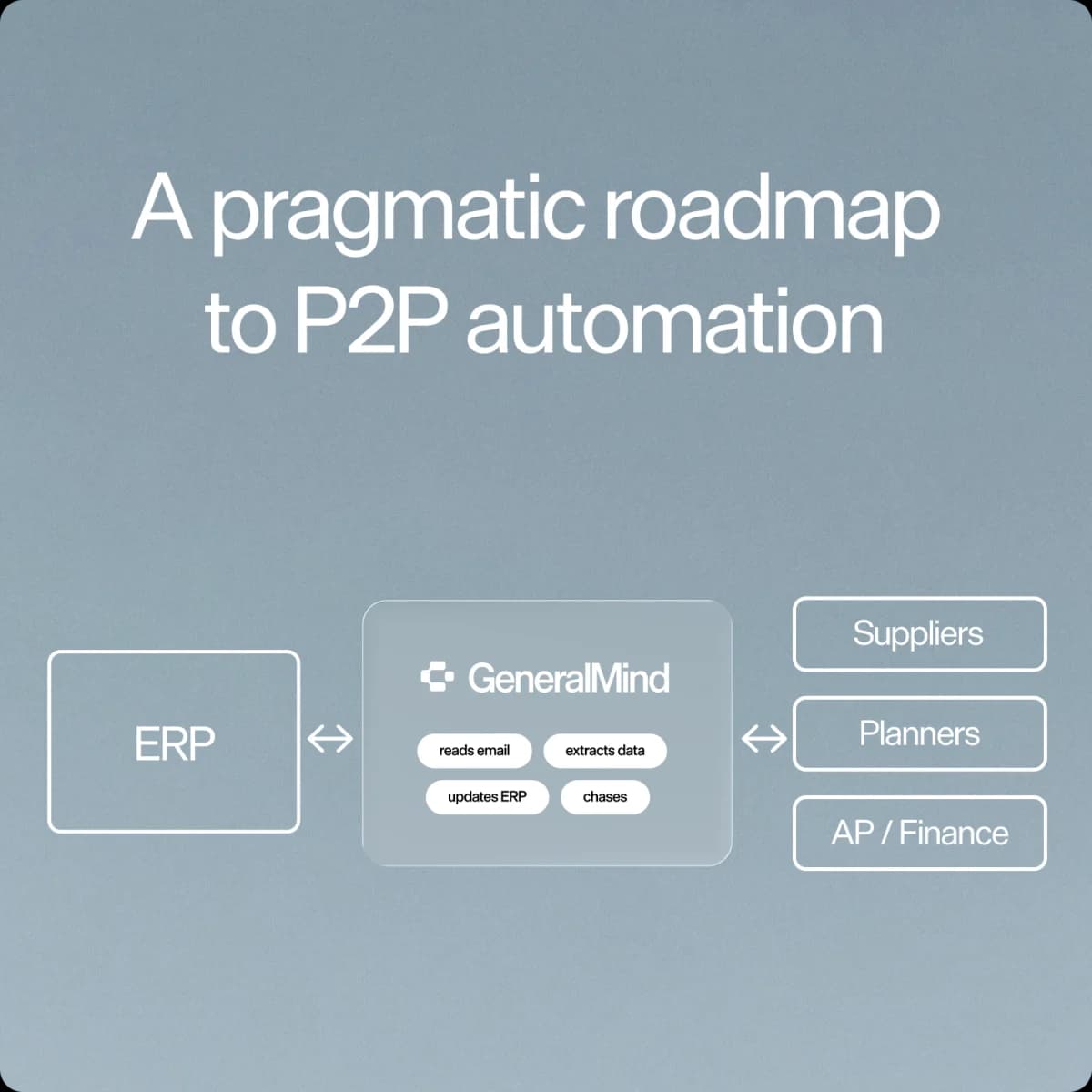
Coexistence needs no changes inside the suite. Oracle Fusion stays the system of record and keeps running requisitions, approvals, negotiations and reporting. GeneralMind sits on the purchasing mailbox, reads what suppliers send and writes confirmed dates, quantities and prices back through the API.
The split is by data type rather than by process step: structured documents that arrive clean go straight into Oracle, and everything arriving as email, PDF or spreadsheet passes through GeneralMind first and reaches Oracle as structured data. The same holds mid-rollout — GeneralMind can run over the legacy ERP during the Fusion programme and follow the same purchase orders into Oracle at cutover, because the connection is an API mapping rather than an embedded module.
FAQ
Frequently Asked Questions
Yes — it connects to Oracle, SAP, Microsoft Dynamics, Infor and 100+ systems via lightweight API, working as an operational layer without migration. It reads open orders and master data and writes confirmations back.
GeneralMind automates the unstructured communication layer Oracle doesn't process autonomously, and books results back to the ERP. Oracle Fusion covers the structured source-to-settle process once data is inside the system.
Per transaction, starting at go-live — outcomes rather than seats or licenses. The cost line follows processed volume, so a pilot on one business unit is priced like a pilot.
Yes — EU data residency, ISO 27001:2022, ISO 27701, SOC 2 Type II, GDPR by design. Hosting is in Frankfurt with disaster recovery in Stockholm, and every automated booking carries an audit trail back to the source document.
No. No module to install, no configuration change in the suite, no migration. GeneralMind connects to the mailbox and to Oracle's API, and writes only above the confidence threshold you set.
Around 85% of cases book correctly on day one, 93–95% within weeks as the system learns your master data, and past 90% autopilot in roughly six weeks. You control the threshold, so raising it is a decision rather than a switch that flips itself.