GeneralMind vs OCR Tools: OCR vs AI Document Processing
OCR turns a document into fields. That is a real capability, and for a stable, high-volume stream of identical forms it is often the only one you need. The question in OCR vs AI document processing is what happens to those fields next: someone still has to match them to the right purchase order line, decide whether a five-day date change is acceptable, reply to the supplier, book the result, and chase the confirmations that never came back. GeneralMind runs that whole path and uses extraction as one step inside it. OCR tools stop at the field.
Key takeaways
- OCR extracts. It does not match, decide, reply or book. The coordination work after extraction is where order-processing teams spend their hours.
- Template-based capture degrades every time a supplier changes a layout, and every new supplier needs a template built before the first document automates.
- A vision-language approach reads documents it has never seen: around 85% correct on day one, 93–95% once it has learned your master data.
- At Klöckner, GeneralMind books 81% of order lines with zero human edits across 150 suppliers and more than 1,100 PO lines a week.
- For one stable form arriving in high volume, classic OCR is cheaper, faster to buy and entirely sufficient. Do not buy an agent to do a scanner's job.
What classic OCR does well
Character recognition on clean printed text is close to a solved problem, and it is worth saying so plainly. A well-tuned template on a stable layout hits high field accuracy, runs in milliseconds per page, costs almost nothing per document, and returns the same answer every time. That determinism is easy to test, easy to explain to an auditor, and it does not drift.
If your inbound is forty thousand near-identical remittance advices a month from three banks, or delivery notes from one logistics provider on a form unchanged since 2019, classic capture is the correct tool and an AI layer on top is overhead. Bulk digitisation is the same story: turning an archive of scanned paper into searchable text is the job OCR was built for.
GeneralMind is not an argument against that — extraction of this kind sits inside our own pipeline as one component along the way. The disagreement is about how much of the work reading a document removes.
OCR vs AI document processing: what happens after extraction
An order confirmation lands in the shared mailbox. OCR hands you the supplier, a document number, fourteen line items, quantities, prices and dates. Now the real work starts.
Which of your POs does the supplier's reference correspond to, given they quote their own order number and not yours? Line three carries the supplier's article code, not your material number. The quantity reads 480 against 500 ordered. Delivery has moved from 12 May to 19 May. The unit price is up 2.4%.
Each of those is a decision measured against your master data and your rules. Is a seven-day slip tolerable for this material, or does it break a production date? Does 2.4% sit inside the contracted price corridor? Is the short quantity a partial delivery with the remainder to follow, or a shortfall someone must query today?
Classic capture holds none of that context. No view of the open PO, no tolerance thresholds, no history with this supplier. The extracted fields land in a validation queue and a person works through them line by line. This is why improving extraction accuracy from 92% to 96% barely moves total handling time. Typing was never the bottleneck. Deciding was.
The template problem: every layout change is a small outage
Template-based capture pins fields to coordinates or anchors on a layout it already knows. It works until the supplier moves the totals block, adds a VAT line, switches billing systems after an acquisition, or sends the same order from a different subsidiary on a different form. Then extraction returns nothing — or, worse, a plausible wrong value in the right field that nobody catches until reconciliation.
Someone spots it in the exception queue, raises a ticket, the template gets remapped. Across 150 suppliers each shipping a layout change or two a year, that is a permanent maintenance load rather than a one-off setup cost. New suppliers pay the same tax in advance: the template has to exist before the first document can be automated, so the unfamiliar documents you most want covered are the ones that fall through.
Vision-language reading works from meaning rather than position. It identifies the total because it recognises what a total is on a commercial document, so a layout nobody has ever configured still parses. Across a real supplier mix that produces roughly 85% correct extraction on day one, rising to 93–95% as the system learns your material master, unit conventions and supplier quirks. No template library, no per-supplier setup.
Matching to the PO line is where the hours go
Matching sounds mechanical and is not. Supplier article codes have to resolve to internal material numbers. Units have to convert — pieces against metres, kilograms against sheets. One ordered line often comes back as three confirmed lines because the supplier split the delivery, and one confirmation frequently covers four POs. A free-text note halfway down the page ("Pos. 3 entfällt, Ersatz folgt separat") changes the meaning of the structured table above it.
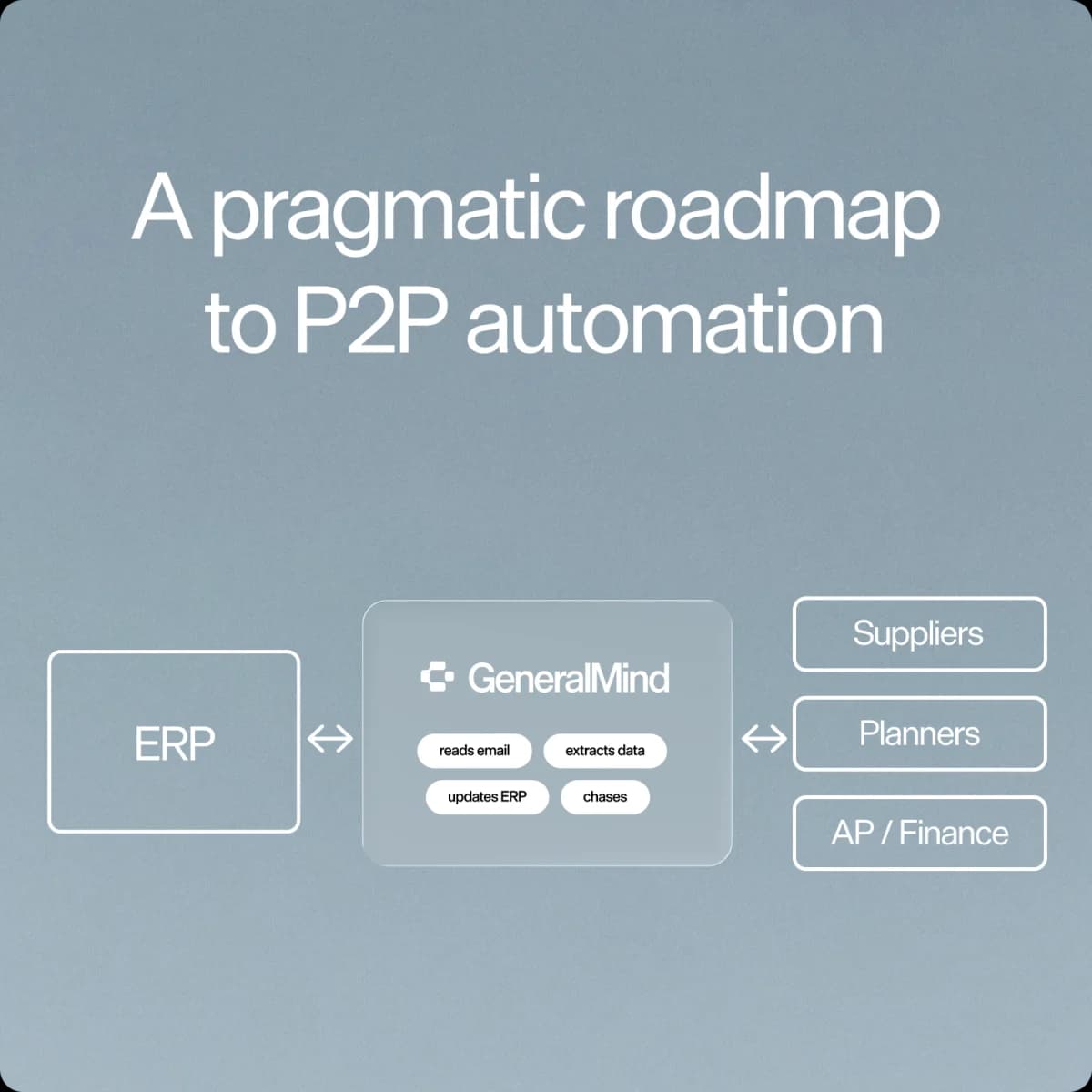
GeneralMind resolves these against your live master data and the open order book, scores each match, and writes nothing below your confidence threshold. Routine lines book straight through: 81% at Klöckner with no human edit, across 1,100+ PO lines a week. Everything uncertain escalates to an operator with the proposed booking already filled in, so the job is to confirm or correct rather than read the PDF again from the top. It connects to what you already run — SAP, Microsoft Dynamics, Oracle, Infor and 100+ systems — with no ERP modification, and goes live in weeks.
Replying, booking and chasing: the loop OCR never enters
A document is one half of an exchange. The other half is the reply.
When a date slips beyond tolerance, someone has to write to the supplier, in their language, referencing the correct PO line, then match the answer back to the same case when it arrives three days later in a different thread. When a confirmation never comes, someone has to notice on day three, follow up on day seven and escalate on day ten. When everything checks out, someone keys the confirmed dates and quantities back into the ERP.
Capture tools emit a payload and stop. The conversation, the follow-up and the write-back stay in a human's mailbox, which is where the hours were before the tool was bought. GeneralMind drafts the query, sends it or holds it for approval according to your rules, reads the supplier's answer when it lands, updates the case and writes the result back. The comparison below puts that at a 70%+ reduction in manual coordination overhead — the reason a team can add volume without adding headcount.
Audit trails: a scan is not a record of a decision
Capture tools store the input document and, if you are lucky, a per-field confidence value. That answers "what did the page say". It does not answer what an auditor asks: who accepted this 2.4% price increase, against which rule, and when.
GeneralMind logs every action with the agent identity, timestamp and reasoning, and tracks human overrides separately, so the record shows both what the system decided and where a person intervened. Hosting is in Frankfurt with disaster recovery in Stockholm, under ISO 27001:2022, ISO 27701 and SOC 2 Type II, and GDPR-compliant by design.
OCR vs AI document processing: the capability matrix
The matrix below scores both approaches across fourteen operational capabilities. Read it as a map of where the two tools sit on the process, not as a scorecard — several rows describe work that capture software was never designed to do.
Legend: ✓ fully supported · ~ partial · ✗ not supported
| Capability | GeneralMind | OCR tools |
|---|---|---|
| Scalability & Workforce | ||
| Scalable workforce — Expand throughput without proportional headcount growth | ✓ Autopilot operates across all workflows at any volume | ✗ Reduces data entry only; no decision-making scale |
| Flexible tool stack — Operate across email, ERP, chat, and document formats natively | ✓ Native connectors across all enterprise tool types | ~ Works with structured docs; limited input formats |
| Scalable exception handling — Resolve edge cases and anomalies at volume without human escalation | ✓ Learns patterns; auto-resolves or routes intelligently | ✗ No reasoning capability; cannot process exceptions |
| Operational Reliability | ||
| Clean data entry — Structured, validated capture from unstructured inputs at the source | ✓ Validates, transforms, and reconciles data at source | ~ Reduces transcription errors; misses semantic context |
| Operational compliance — Consistent policy adherence enforced across every transaction | ✓ Policy engine embedded in every automated action taken | ~ Flags deviations in documents; does not enforce policy |
| Accurate ETA synchronisation — Real-time sync of delivery dates, PO status, and supplier data | ✓ Live sync across ERP, email, and supplier portals | ✗ Reads documents only; no live data synchronisation |
| Early risk detection — Proactive identification of supply disruptions before they escalate | ✓ Pattern-based detection across all live data streams | ✗ No predictive or anomaly detection capability |
| Audit, Compliance & Accountability | ||
| Immutable audit logs — Tamper-proof records of every decision and system action taken | ✓ Every action logged: agent ID, timestamp, reasoning | ✗ Captures input documents; no structured action log |
| Clear accountability buckets — Traceable ownership of every decision across teams and systems | ✓ Agent-level attribution with human override tracking | ✗ No decision attribution capability at any level |
| Data Quality & Intelligence | ||
| KPI-level data generation — Automatic production of procurement performance metrics in real time | ✓ Real-time KPIs generated from every automated action | ✗ Data extraction only; no metric computation layer |
| Unstructured data processing — Parse and act on emails, PDFs, chat messages, and documents | ✓ Multi-modal understanding across all input format types | ~ Reads text from images; limited semantic understanding |
| Institutional knowledge independence — Operate reliably without reliance on individual staff expertise | ✓ Learns and encodes institutional patterns automatically | ✗ No contextual or institutional understanding at all |
| Implementation & Cost | ||
| Low implementation risk — Deploy without long integration projects or operational disruption | ✓ Live in weeks; no ERP modification required | ~ Moderate setup scope; limited operational disruption |
| Reduced coordination cost — Lower cost per transaction by automating routine manual work | ✓ 70%+ reduction in manual coordination overhead | ~ Reduces data entry cost; coordination overhead persists |
| Coverage score | 14 / 14 | 3 / 14 |
When to choose which
Choose classic OCR when the document stream is narrow and stable: one or two formats, high volume, few suppliers, layouts that change rarely, and a downstream process that is already automated or already cheap. Archive digitisation, forms processing, scanned contracts you need to search — all of it fits, at a cost per page no reasoning system will match. If your team's complaint is "we retype the same six fields", OCR fixes your problem and you should buy OCR.
Choose GeneralMind when the complaint is different: "we spend the morning working out what these confirmations mean." That is the case with a long tail of suppliers on formats you do not control, when a meaningful share of documents needs a query rather than a booking, and when the process spans a mailbox, an ERP and a portal rather than one scanner queue.
The two also sit fine side by side: keep a capture tool on the stable single-format stream it already handles well, and put GeneralMind on the messy remainder where the decisions live.
FAQ
Frequently Asked Questions
No. OCR converts pixels into characters and, with a template, characters into named fields. AI document processing adds interpretation: what the document means, how it matches your existing records, which of your rules apply and what to do next. Many products marketed as intelligent capture are OCR with a machine-learning classifier in front — useful, but still ending at the field.
Yes, as one component. Text recognition is part of reading a scanned or image-based PDF, and there is no reason to reinvent it. What sits on top is the difference: vision-language understanding of the whole page, matching against your live master data and open orders, policy checks, the supplier reply and the ERP write-back.
A template anchors extraction to a known layout. Any structural change — a moved totals block, a new tax line, a supplier migrating to a new billing system — invalidates those anchors, and the document either fails or returns a wrong value in the right place. The cost is rarely a single incident: it is the standing queue of remapping tickets plus the template build required before every new supplier can be automated at all.
Yes. Extraction works from the meaning of the page rather than a stored layout, so a first-time supplier's confirmation is processed on arrival with no configuration step. Accuracy on an unfamiliar mix typically starts around 85% and improves as the system learns your master data, reaching 93–95% within weeks and passing 90% on full autopilot in roughly six weeks. That is the pattern across deployments rather than a contractual figure, and every uncertain case escalates to an operator instead of being guessed.
For a high-volume single-format stream with a clean downstream process, yes. It stops being the better answer when your team's time goes into deciding and communicating rather than typing — when invoices need matching against receipts and POs, when disputes need a reply, and when someone has to chase what never arrived.