GeneralMind vs ERP-native automation
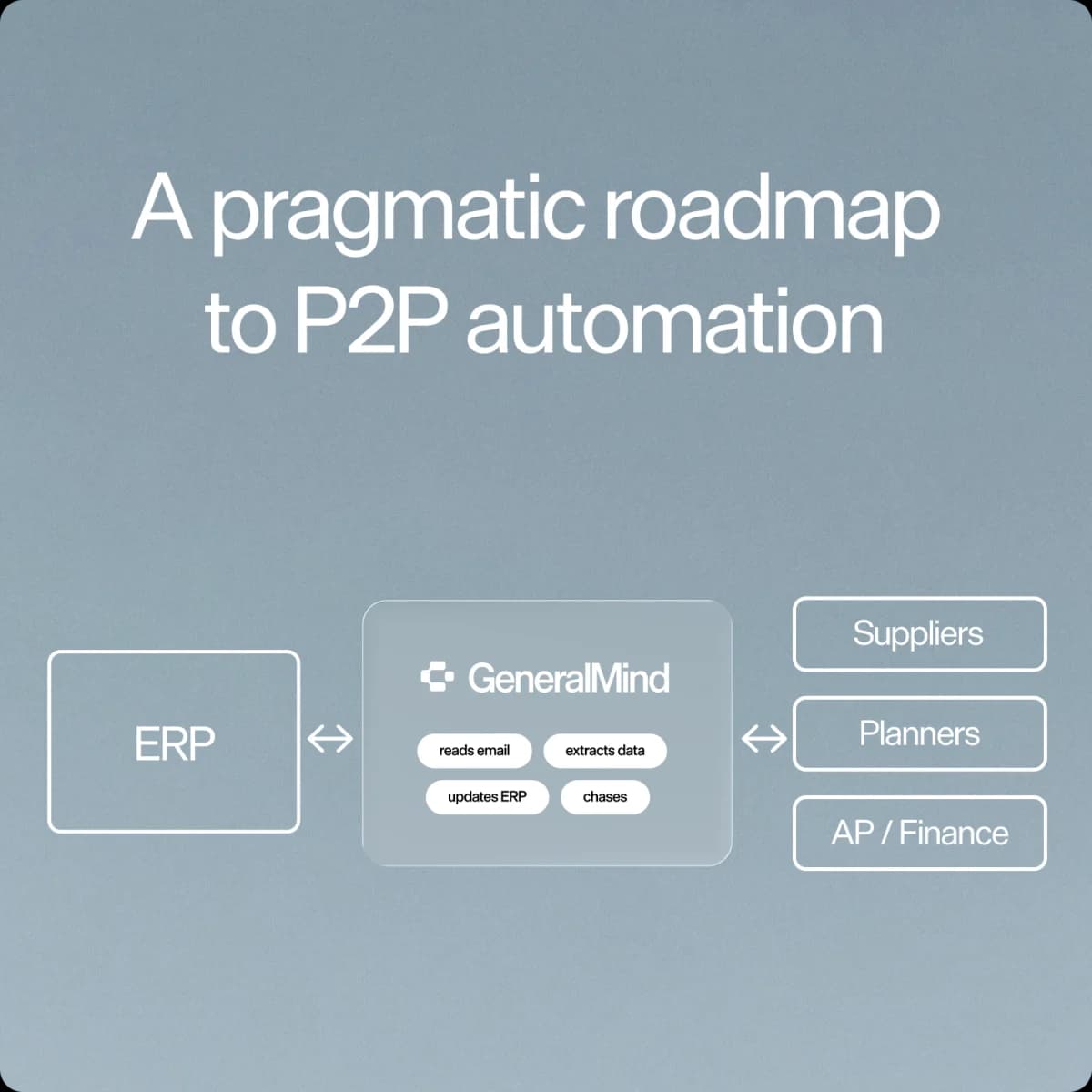
ERP-native automation is good at what it was built for: acting on data that is already structured and already inside the system. Approval workflows, release strategies, rules on existing records, standard reports — SAP, Oracle, Dynamics and Infor all handle that layer competently, and you have already paid for it. None of them was designed to read what arrives before that point: a supplier confirming an order in the body of an email, a PDF that moves a delivery date on line seven, an Excel sheet of revised prices. GeneralMind works that unstructured layer, decides what the message means, and writes the validated result into the ERP through its own interfaces. The ERP stays the system of record. Nothing is replaced.
Key takeaways
- ERP-native workflow engines act on records that already exist in the ERP. Everything upstream — email bodies, PDFs, spreadsheets — has to be read and keyed in by a person before a rule can fire on it.
- GeneralMind reads those inputs, matches them against your master data, decides, and posts the result. No ERP modification, no custom fields, no schema change, no migration.
- At Klöckner, 81% of order lines book with zero manual edits, across 150 suppliers and more than 1,100 PO lines a week. A typical deployment starts near 85% extraction accuracy on day one, reaches 93–95% within weeks, and passes 90% autopilot in roughly six weeks.
- ERP-native automation stays the right answer for rules-based approvals, anything already structured, and teams with low inbound document volume. The two layers are complementary.
What ERP-native automation genuinely does well
Give the ERP a clean, structured record and its automation is hard to beat. A three-way match between purchase order, goods receipt and invoice runs on posted documents with defined fields, and SAP, Oracle Fusion and Dynamics 365 all do it reliably. Release strategies and approval hierarchies — spending limits, cost-centre ownership, holiday delegation — live where the org chart and the user master already live. Standard reporting reads the same tables the transactions wrote to, so the numbers reconcile by construction.
The non-functional advantages matter just as much. No additional vendor, no additional data-processing agreement, no additional login. Authorisations follow the roles your team already maintains, auditors have seen the change documents before, and configuration ships through the same dev/QA/production transport path as everything else. For a process that starts and ends inside one ERP with no external counterparty, building automation anywhere else is the wrong call.
Where ERP-native automation stops: the unstructured layer
A rule cannot fire on a record that does not exist yet. That is the whole limitation, and it is structural rather than a gap any vendor will patch. An order confirmation that arrives as a PDF attachment is not a record — it is a file in a mailbox. Someone opens it, compares 14 line items against the PO, spots that line seven now ships on the 12th instead of the 4th and line nine came back at €4.18 instead of €4.05, then keys those two changes into the ERP. Only then does the workflow engine have something to act on.
The matrix below scores ERP-native automation as “structured data only” on unstructured input, and that is the honest read. The formats vary too much for field mapping: across 150 suppliers, no two confirmation layouts match, and the same supplier changes theirs without notice. EDI covers the vendors who are onboarded and sending EDI 855 — in most European manufacturing bases a minority of the list and a larger share of the volume. GeneralMind uses vision-language extraction to read any layout in any language, then context-based matching to resolve the message to the right PO and line item. The output is a structured, validated change the ERP accepts as if a person had typed it.
Rules fire; judgment decides
The second gap sits one step further along. Suppose the confirmation is already parsed and both deltas are visible: one line is 3.2% above the ordered price, another slips nine days. An ERP threshold rule can flag both — that is what tolerance limits are for. Deciding is a different task. Is 3.2% inside the agreed band for this material with this supplier under this contract, or is it the third increase this quarter and worth a query? Does a nine-day slip matter, given the safety stock on that part and the production date it feeds? Those calls are why exception queues fill up and why an “automated” process still consumes a planner’s morning.
GeneralMind scores each decision and acts on the score. Routine cases post straight through. Anything below your confidence threshold escalates to an operator with the source document, the extracted values, the proposed booking and a pre-drafted supplier reply — so the human step is an approval, not an investigation. Every correction becomes permanent system knowledge, which is why accuracy moves from around 85% on day one to 93–95% within weeks. An ERP workflow does not improve with use; on day 400 it does exactly what it was configured to do on day one.
The audit trail ends at the system boundary
ERP change documents are strong records of what happened inside the ERP: which user changed which field, from what value, at what time. They say nothing about the preceding half hour. Which email did that delivery-date change come from, was there an earlier version of the confirmation, and who decided the price variance was acceptable? That evidence lives in a mailbox, and mailboxes are not audit systems. This is why the matrix marks ERP-native audit logging as partial rather than absent — it is complete for the half of the process it can see.
GeneralMind logs the other half. Every action carries the source document, the extracted values, the confidence score, the matching decision, an agent ID, a timestamp, the reasoning, and any human override with the operator who made it. Because the layer sits between the mailbox and the ERP, the chain runs unbroken from the supplier’s PDF to the posted document number. Hosting is in Frankfurt with disaster recovery in Stockholm, under ISO 27001:2022, ISO 27701, SOC 2 Type II and GDPR.
Implementation: changing the ERP versus sitting beside it
Extending ERP-native automation means touching the ERP. New workflow definitions, sometimes custom fields, sometimes ABAP or extension code, then transports through development and QA, regression testing, and a re-test at every upgrade. The source matrix puts full ERP automation programmes at 12–24 month cycles; wherever your own lands in that range, the change-control overhead does not go away after go-live.
GeneralMind connects over the mailbox you already use and the ERP’s existing API, with more than 100 connected systems and no modification to the ERP — the matrix scores this as a low-risk rollout measured in weeks. The consequence shows up in fragmented landscapes. A group running SAP in two divisions, Dynamics in a third after an acquisition and Infor in a plant would have to build and maintain the same automation three times natively. One layer above them works the same supplier mailbox whichever system the document lands in.
GeneralMind vs ERP-native automation: the capability matrix
The matrix scores both layers across 14 capabilities, where ERP native means the automation shipped inside SAP, Oracle and Dynamics. A partial mark is not a failure: in most cases it means the capability is complete inside the ERP and stops at its boundary.
_ERP native: SAP, Oracle, Dynamics_
| Capability | GeneralMind | ERP native |
|---|---|---|
| Scalability & Workforce | ||
| Scalable workforce — Expand throughput without proportional headcount growth | ✓ Autopilot operates across all workflows at any volume | ✗ Process-bound; no adaptive workforce layer |
| Flexible tool stack — Operate across email, ERP, chat, and document formats natively | ✓ Native connectors across all enterprise tool types | ✗ Locked to ERP ecosystem; external tools unsupported |
| Scalable exception handling — Resolve edge cases and anomalies at volume without human escalation | ✓ Learns patterns; auto-resolves or routes intelligently | ✗ Rigid workflows; no exception intelligence layer |
| Operational Reliability | ||
| Clean data entry — Structured, validated capture from unstructured inputs at the source | ✓ Validates, transforms, and reconciles data at source | ~ Clean within ERP; degrades at system boundaries |
| Operational compliance — Consistent policy adherence enforced across every transaction | ✓ Policy engine embedded in every automated action taken | ~ Enforced within ERP workflows; external gaps remain |
| Accurate ETA synchronisation — Real-time sync of delivery dates, PO status, and supplier data | ✓ Live sync across ERP, email, and supplier portals | ~ Syncs within ERP; external supplier data gaps persist |
| Early risk detection — Proactive identification of supply disruptions before they escalate | ✓ Pattern-based detection across all live data streams | ✗ Threshold alerts only; no predictive modelling |
| Audit, Compliance & Accountability | ||
| Immutable audit logs — Tamper-proof records of every decision and system action taken | ✓ Every action logged: agent ID, timestamp, reasoning | ~ Logs ERP actions; all external actions untracked |
| Clear accountability buckets — Traceable ownership of every decision across teams and systems | ✓ Agent-level attribution with human override tracking | ~ User-level attribution within ERP context only |
| Data Quality & Intelligence | ||
| KPI-level data generation — Automatic production of procurement performance metrics in real time | ✓ Real-time KPIs generated from every automated action | ~ Structured KPIs for in-ERP data only; gaps elsewhere |
| Unstructured data processing — Parse and act on emails, PDFs, chat messages, and documents | ✓ Multi-modal understanding across all input format types | ✗ Structured data only; no unstructured input handling |
| Institutional knowledge independence — Operate reliably without reliance on individual staff expertise | ✓ Learns and encodes institutional patterns automatically | ✗ Process-only; no embedded knowledge or learning layer |
| Implementation & Cost | ||
| Low implementation risk — Deploy without long integration projects or operational disruption | ✓ Live in weeks; no ERP modification required | ✗ Complex ERP projects; 12–24 month implementation cycles |
| Reduced coordination cost — Lower cost per transaction by automating routine manual work | ✓ 70%+ reduction in manual coordination overhead | ~ Cost reduction within ERP-managed workflows only |
| Coverage score | 14 / 14 | 3.5 / 14 |
✓ fully supported · ~ partial · ✗ not supported
When to choose which
Stay with ERP-native automation when the work is already inside the ERP. Requisition approvals, release strategies, spending limits, delegation rules, three-way matching on posted documents, period-close checks — these run on structured records, the logic belongs next to the data, and an external layer would only add a dependency. The same applies if your inbound document volume is genuinely low: a team handling twenty supplier documents a day does not have an automation problem worth a platform. And if your supplier base is largely EDI-enabled with high adoption, the structured channel plus native workflow already covers most of the volume.
Choose GeneralMind when the bottleneck is reading and deciding on what arrives from outside. The signals are recognisable: an exception queue that never empties, a shared mailbox two people work full time, planners chasing confirmations instead of planning, delivery dates everyone knows are stale, and a process that holds together because one long-serving colleague remembers how each supplier writes. At 1,100 PO lines a week, the manual read-and-key step constrains everything downstream.
Running both: the ERP stays the system of record
This is not a replacement decision, and framing it as one leads to the wrong answer. The division of labour is clean: GeneralMind owns the stretch from inbound message to validated, structured data; the ERP owns everything from the posting onward. Approvals still run through SAP Business Workflow or the Dynamics flows your finance team configured, and master data stays in the ERP. Reporting stays on the ERP tables, which are now accurate more often, because the delivery dates in them arrived within minutes of the supplier sending them rather than whenever someone got to the attachment. Nothing in the ERP changes, so nothing in the ERP can break.
FAQ
Frequently Asked Questions
No. Approval workflows, release strategies and matching rules stay where they are. GeneralMind sits in front of them, turning supplier email, PDFs and spreadsheets into validated records those workflows can act on.
No. GeneralMind reads and writes through the interfaces the ERP already exposes, with no custom fields, no schema changes and no transports required. That is why deployment takes weeks rather than an ERP project, and why an upgrade on the ERP side does not put the automation at risk.
Those documents arrive structured and the ERP handles them well. GeneralMind covers the remainder: suppliers not on EDI, the ad-hoc changes that EDI-enabled suppliers still send by email, and the confirmations that arrive as PDF because someone at the supplier bypassed the process.
Every action is logged with an agent ID, timestamp, source document, extracted values, confidence score and reasoning, so a wrong booking can be traced back to its input. Anything below your confidence threshold never books autonomously in the first place — it goes to an operator, and the override is logged against that person.
A typical deployment books around 85% of cases correctly on day one, reaches 93–95% as it learns your master data over the following weeks, and passes 90% autopilot in roughly six weeks. That is the observed pattern across deployments rather than a contractual figure; volume, supplier mix and master-data quality all move the curve.
Yes. The layer connects to more than 100 systems and is not tied to a single ERP, so a group running SAP, Dynamics and Infor across divisions works one supplier mailbox and posts into whichever system owns the order.